Recent security events have had a significant impact on Israeli design trends and planning priorities. Whether in public buildings or private homes, the focus has shifted to safety and protection, with less emphasis on aesthetics. Some professionals are working to balance both needs, while others are already thinking one step ahead—exploring how underground space can serve multiple functions. Just like land shortages force construction upward to high rise buildings, why not also build downward?
By Hadas Magen, Nadlan Center
The day before an Iranian missile struck the Tel Aviv Stock Exchange complex in Ramat Gan, Arteferro—a company that makes iron-framed windows and doors—had delivered windows to the historic Elite factory restoration project at the nearby junction of Jabotinsky, Abba Hillel, and Arlozorov streets. When the missile hit, many surrounding buildings were damaged and windows shattered—except for the iron-framed ones, whose thick glass and strong steel held firm.
Iron doors and windows, often referred to as “Belgian windows,” are currently found mostly in private homes and select public buildings. Will we start seeing them in high-density residential projects as a protective measure? It’s too soon to tell. What’s clear, says Kobi Halifa, CEO of Arteferro, is that “the conversation has shifted—less about aesthetics, more about safety and protection.”

At Rav-Bariach, the shift in mindset is just as clear. “We’ve definitely noticed a change in customer preferences since the war,” says Maya Donnerstein-Yatir, VP of Marketing at the Rav-Bariach Group. “Where people once liked entry doors with glass panels as a design feature, that’s now much less common. In today’s security climate, glass is seen as a weak point, and more homeowners are opting for solid doors that offer greater peace of mind.”
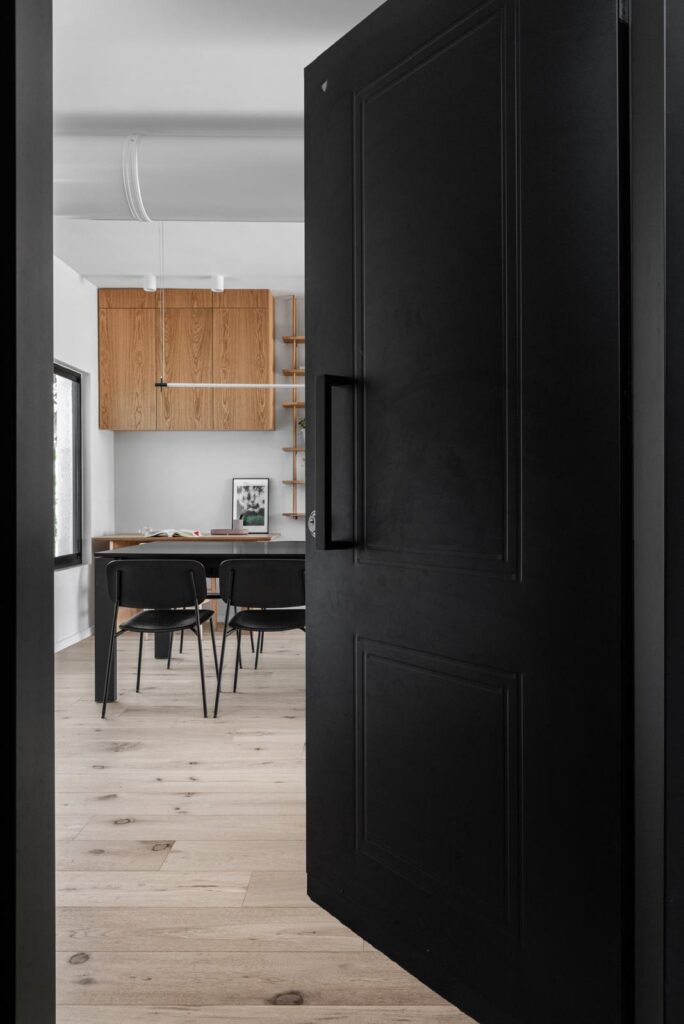
“There’s also growing demand for entrance doors with higher levels of protection—from upgraded locking mechanisms to reinforced bolts that offer a greater sense of safety,” she adds. “It doesn’t necessarily affect the aesthetics, but it’s a major factor in decision-making.” Previously, many households removed their heavy, less visually appealing mamad (protected room) doors and stored them in basements. Today, given the clear need, “people are keeping them in place—even if they don’t match the décor.”
This change has reached the luxury sector, too. “Imported doors were once a strong trend,” says Donnerstein-Yatir. “Now we’re seeing increased demand—both from contractors and homeowners—for high-protection Israeli-made doors. Since the war, personal security has become a key part of Israeli design trends.”
“Transforming protection into functionality—and beauty”
For architect Aviva Friedman, a partner at Zarta Architects, this isn’t new. Her firm operates in the Gaza Envelope area, and until October 7, their office was located in Kibbutz Nir Am. After the war broke out, they relocated to Kiryat Malakhi. Zarta has long been designing public spaces, neighborhoods, and buildings in the region, where safety has always been a central concern. “We’ve been living this for years—whether it’s meeting safety regulations or integrating them into our designs,” Friedman says. “It’s just another layer in our planning. Security is an inseparable part of Israeli design trends in this region. We even address it in our zoning plans.”
“Each stakeholder comes with their own set of demands,” says Friedman, “but there has to be collaboration to bring everything together. We need to make sure that protective measures don’t come at the cost of pedagogy or well-being. It’s about managing risk—it’s not all or nothing.”
At one end of the spectrum, says Friedman, are the increasingly stringent requirements from the Home Front Command. At the other end are their visual implications. Zarta’s role is to strike a balance, creating synergy between security demands and aesthetic goals. For example, they’re currently designing a 40-dunam public space in Sderot that includes public buildings, a synagogue, and other uses. It’s not just the buildings that incorporate protection—so do the open areas. Instead of placing scattered reinforced structures around the site, they designed quick-access outdoor entrances into protected zones.
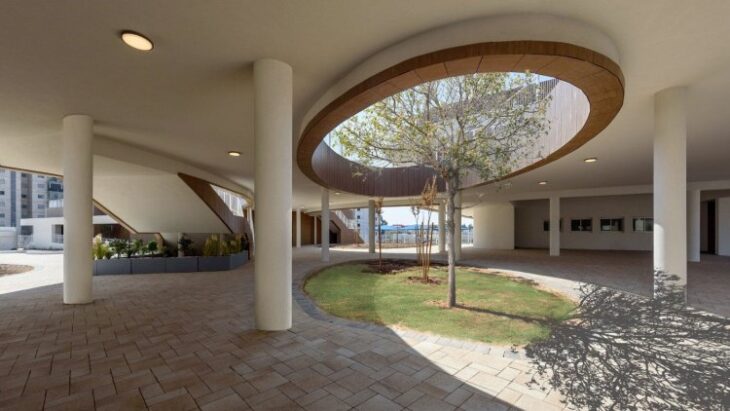
The building is shaped like a mushroom, with the second floor extending beyond the first to provide both shade and shelter. In border towns where a hiding wall is needed, greenery is incorporated into the design. “We try to find ways to turn security requirements into an advantage,” Friedman explains. “The challenge is making something that’s both functional and meets Home Front Command standards—and still looks beautiful.”
She notes a rise in requests from private homeowners as well. “We’re getting asked to thicken walls, use smaller windows that can’t be breached, and eliminate bathroom vents to prevent entry.” In schools and other public buildings, the firm works to integrate protective elements without compromising visual appeal. Their solutions aim to bring nature indoors—through design elements like patios—while also meeting safety standards.
Do the authorities understand the complexity of balancing security and design?
“Not enough,” says Friedman. “There isn’t enough joint work between the different bodies. Each one brings their own list of demands, but we need true collaboration. The goal is to maintain pedagogical integrity and user comfort while meeting security needs. It’s about understanding how protection impacts the structure and the people inside. Everyone has to sit at the same table and negotiate the trade-offs. And budgeting is a huge piece that’s often overlooked.”
Is the solution to go underground?
While some are thinking about protection above ground, others are looking underground. Until the war with Iran, architect Einav Ziv, a partner at Miloslavsky Architects, struggled to “sell” her agenda around subterranean planning. Having worked in firms in the U.S. and Europe—where underground spaces are fully active and integrated into daily life—Ziv believed there was no reason Israel couldn’t follow suit. But until the recent war, her ideas were seen as fringe. “Until now, we got the cold shoulder,” she says. “Now I feel the conversation has really changed. We’ve been trying to promote these ideas for years, and suddenly there’s openness—we’re pushing as hard as we can.”
“In the last war, we saw how sought-after underground spaces became,” she continues. “Often, even people with a mamad in their apartment preferred to take shelter underground—whether in a public shelter, a parking garage, or a light rail station—not only for safety, but for emotional comfort. We saw people gathering together, forming communities. People felt much more at ease being around others.”
Until now, basements were viewed purely as a necessity—mainly used for parking, logistics, and delivery zones—and developers often clashed with municipalities to minimize investment in them. “That space used to be something developers wanted to spend as little as possible on,” Ziv explains. “Now, it’s become valuable. The tone of the conversation is completely different.”
Ziv says the change is so significant, it has become a kind of social phenomenon. “People started ‘shopping’ for shelters. Protected spaces turned into valuable real estate, and people became critical of the spaces available to them. They started reorganizing them, painting, adding cushions. These spaces became almost like community lounges. I even heard stories of people staying to chat with neighbors long after the all-clear siren.”
Until now, basements were viewed purely as a necessity—mainly used for parking, logistics, and delivery zones—and developers often clashed with municipalities to minimize investment in them. “That space used to be something developers wanted to spend as little as possible on,” Ziv explains. “Now, it’s become valuable. The tone of the conversation is completely different—much more open and nuanced.”
“We’re realizing there’s so much unused potential underground. There’s no reason we can’t have fully functioning underground spaces—like theaters, museums, or shops. In train stations abroad, there’s vibrant underground activity, while in Israel you can’t even buy a cup of coffee. Of course, it needs to be done well—with natural light, air circulation, and easy, accessible entry. But suddenly the idea of full underground functionality doesn’t sound so extreme. This exists in many countries—Europe, Japan. Penn Station in New York has five underground levels. We don’t have to build only upward. Until now, there was a psychological barrier, partly because underground planning and construction are more expensive—but now the conversation has shifted.”
As part of this shift in thinking, Ziv says there’s increasing discussion about how to turn metro stations into protected spaces—through sealing methods and wall reinforcement. There’s also a renewed conversation about the design of protected rooms: “There’s talk of locating the mamad deeper inside the home—maybe as a walk-in closet—because there’s a growing awareness that a mamad facing the street could pose a problem.”
What about schools?
“There’s no reason for learning to stop,” says Ziv. “We just need to protect students. Emergency classrooms could be created—like how extracurricular classes are held in public shelters. Many functions can work perfectly underground, and people wouldn’t even notice. Think about being in a shopping mall—you don’t always know what floor you’re on.”
Ziv also predicts a trend where developers will place residents’ lounges not on the ground floor, but underground in parking areas—adding function to previously unused levels. She expects that local municipalities, when approving new projects and public buildings, will begin to demand protected spaces as a matter of course.

Nadlan Center is Israel’s leading real estate news and knowledge platform in Hebrew, created for industry professionals. Founded by experts in the field, it delivers in-depth, up-to-date coverage on urban renewal, planning and construction, taxation, and housing policy — tailored to the needs of developers, investors, planners, and financiers. In addition to its widely read news content, Nadlan Center hosts major industry events, professional conferences, and training programs that support the growth and development of the Israeli real estate sector.
Learn more: https://www.nadlancenter.co.il