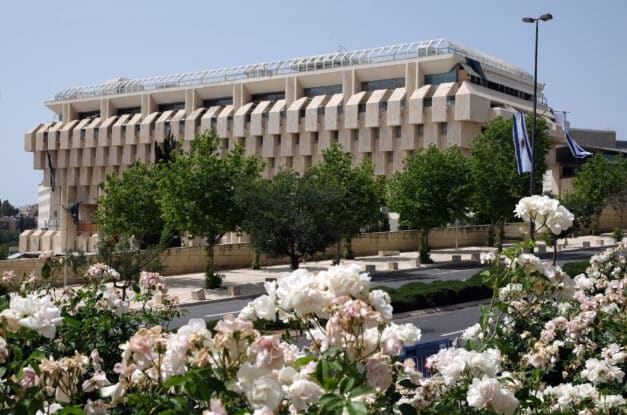
The Bank of Israel left its benchmark interest rate unchanged at 3.25% for the second decision in a row, so the prime rate stays at 4.75%. It held even though annual inflation fell to 1.1% and the shekel weakened sharply against the dollar. The next decision is due on January 4, 2027.
The Bank of Israel’s Monetary Committee, headed by Governor Prof. Amir Yaron, decided on Monday to keep the benchmark interest rate at 3.25%. Most economists expected this: 12 of 14 forecasters in a Reuters survey predicted no change. It was the second hold in a row and the last rate decision of 2026. The prime rate, set 1.5 percentage points above the Bank of Israel rate, remains at 4.75%. Monthly payments on prime-linked mortgage tracks won’t change for now.
A Pause After a Year of Cuts
The decision keeps interest rates frozen after a long run of cuts. The bank started in November 2025 with its first rate cut in nearly two years, from 4.5% to 4.25%. It then cut to 4% in January, 3.75% in May, 3.5% in July and 3.25% on September 1. In October it held, and its Research Department forecast that the rate would average 3% in the third quarter of 2027. That points to only one more quarter-point cut over the coming year.
Inflation Has Fallen Faster Than Expected
The latest data seemed to support a cut. The Consumer Price Index fell 0.1% in October, while economists had expected a rise of about 0.3%. Annual inflation dropped to 1.1%, its lowest level since April 2021 and close to the bottom of the 1%–3% target range. So why keep interest rates frozen? The committee bases its decisions on where inflation is heading. According to the Bank of Israel’s official announcement, forecasters expect inflation to rise in the coming months and to be close to the middle of the target range by early 2027. The bank said the future path of rates will depend on inflation, economic activity, geopolitical uncertainty and the government’s budget.

A Sharp Turn in the Shekel
Between the October decision and November 20, the shekel lost 7.6% against the US dollar and 5.1% against the euro. Israel’s risk premium stayed stable and close to where it was before October 7, 2023. For buyers who earn or save in dollars or euros, a weaker shekel means a property priced in NIS costs less in their own currency. Exchange rates can turn quickly, though, especially for buyers paying in installments. Buyitinisrael looked at this risk in its guide to buying when the dollar-shekel rate is low.
Mixed Signals From the Housing Market
Home prices fell 0.2% in August–September and were 1.5% lower than a year earlier. Seasonally adjusted, home sales rose slightly in September. The stock of unsold homes also grew slightly and remains high. Rents are moving the other way: the housing component of the CPI rose 4.2% over the year to October. Rents on contracts with a new tenant rose 5.5%, and renewed leases rose 2.8%. New mortgages totaled about NIS 10 billion in October. Borrowers with prime-linked tracks saw their payments fall with each cut this year, including the July cut to 3.5%. With interest rates frozen, those payments stay where they are until at least January.
Ron Novotny, owner and CEO of the Anglo Saxon real estate network, says the decision will likely prolong the wait-and-see mood in the housing market. “It’s important to understand that the main problem today isn’t only the level of interest rates, but mainly the uncertainty that makes it hard for households to make major financial decisions,” he said. “Many buyers prefer to put off buying an apartment, even when they can afford to go ahead, in the hope that market conditions will improve or prices will fall further. High financing costs also continue to weigh on buyers, but interest rates alone don’t explain the slowdown in the number of deals.”
Novotny says the slowdown in sales is feeding the rental market. “Households that put off buying keep renting, demand for rentals remains high, and the pressure on rents continues, both in lease renewals and especially in new leases,” he said. “Waiting to buy an apartment comes with a growing cost of its own.” He still sees opportunities in the resale market, especially in realistically priced homes and with sellers who are willing to be flexible. “But as long as the uncertainty continues, it’s hard to expect a significant change in the pace of deals.”
Developers are feeling the pressure too. Gilad Oren, CEO of Mazlawi Construction Company, said the decision “reflects the caution with which the central bank operates, but at the same time continues to weigh on the real estate market.” He said the current rate environment makes things harder for apartment buyers, raises developers’ financing costs and hurts the economics of new projects, especially in urban renewal. “At a time when the market is dealing with slowing demand and high construction costs, it’s very important to create conditions that will allow buyers to return to the market and construction to keep moving forward,” he said. “As economic conditions allow, a rate cut down the line could help the industry recover. It’s important to remember that the basic demand for housing in Israel hasn’t disappeared, and a prolonged slowdown in construction could lead to a supply shortage in the coming years.”
Looking Ahead
The next decision is on January 4, 2027, and will come with an updated economic forecast. Before today’s announcement, financial markets put the chance of a cut today or in January at 43%. Industrialists and groups representing the self-employed had called for the rate to be cut to 3%. The economy gives the bank room to wait: GDP grew at an annualized 8% in the third quarter, and unemployment was 3.3% in October. For now, with interest rates frozen at 3.25%, borrowers get stability rather than relief. Whether the next cut comes in January will depend on whether inflation picks up and on how the shekel moves.
The Buyitinisrael Editorial team is made up of industry experts, journalists, researchers, editors, and translators working together to deliver reliable, up-to-date information about the Israeli property market — all in English. With a strong focus on transparency and accessibility, our goal is to empower English-speaking buyers by helping them understand the market and navigate the real estate process with clarity and confidence.
For inquiries, email [email protected].