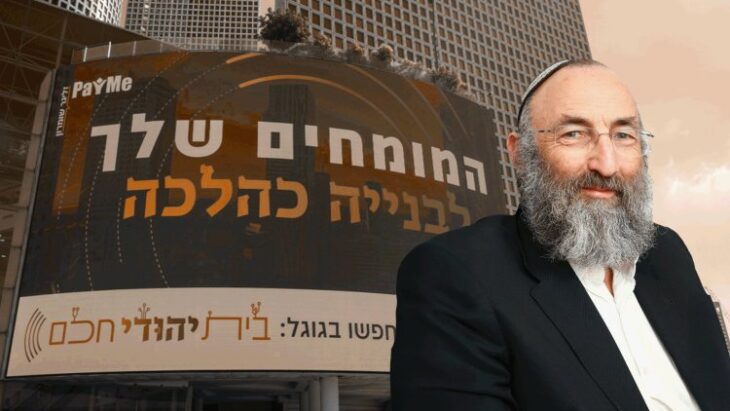
Rabbi Menachem Perl, head of the Zomet Institute, an organization dedicated to adapting technological innovations for religious observance, says modern construction has created countless halachic challenges for religious residents. While “Shabbat elevators” draw most of the attention, other building systems, from electronic waste chutes to motion-sensor lights and digital intercoms, can also lead to inadvertent Sabbath violations. In an interview with Nadlan Center, he calls on developers to consult Zomet for guidance: “The cost during construction is negligible, but once the building is complete, changes are nearly impossible.”
By Doron Breitman, Nadlan Center
In a small and densely populated country like Israel, high-rise living has become the dominant residential form. What began in the Tel Aviv metropolitan area quickly spread to surrounding cities and even Jerusalem, where 20–30 story towers — sometimes alongside lower 10-story buildings — are now part of the urban landscape.
Yet building upward brings complex halachic implications for observant Jews, particularly regarding Sabbath and holiday observance. The most common issues — Shabbat elevators and balconies suitable for sukkot — have already deterred many religious and ultra-Orthodox buyers, slowing urban renewal projects in places like Bnei Brak.

But the challenges extend far beyond those well-known examples. Modern construction, especially in tall buildings, integrates increasingly “smart” systems: water pressure pumps, motion sensors to save electricity, floor heating, electronic toilets, automatic garbage disposal systems, digital entry controls, and smart water and heating systems. Without specific adaptations, such technologies may cause residents to violate Shabbat unintentionally.
Many religious homebuyers are unaware that essential high-rise systems can conflict with halacha. Developers often fail to adapt them, leaving observant buyers facing a double problem. Those aware of the issue avoid purchasing such apartments, while those unaware may only discover the problem post-purchase, unable to modify it later.
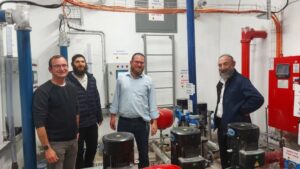
One organization addressing these challenges is the Zomet Institute (Hebrew acronym for “Science and Torah Teams”). Founded nearly 50 years ago, Zomet employs about 20 staff — mostly engineers and rabbis — who develop halachic and technological solutions. Rabbi Perl, who has led the institute for eight years, explains: “Technology should serve us in everyday life — on weekdays and on Shabbat. We embrace it and work to ensure it doesn’t conflict with halacha, so people can enjoy modern convenience while keeping the Sabbath.”
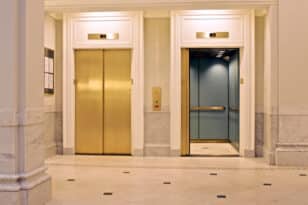
Zomet’s most well-known development for the building industry is its “Shabbat Elevator Control Card”, which is halachically certified and includes an annual inspection by a Zomet supervisor. “The Shabbat elevator is our flagship product,” says Rabbi Perl. “Electric activation is generally prohibited on Shabbat, so our system ensures the elevator stops automatically at every floor, bypassing sensors and adjusting door timing. Thousands of Shabbat elevators in Israel and abroad now operate with our approval — we even have certification from the Standards Institute.”
Beyond elevators, Rabbi Perl highlights several other systems that pose challenges for observant residents: “Lighting in lobbies and stairwells is often motion-activated. Entry doors use electric keypads and intercoms. Some buildings leave the doors unlocked on Shabbat, but that’s not always safe or practical. There are also alarm systems, motion-sensor faucets, and energy-control systems.”
Garbage chutes are another halachic “trap.” Perl explains that modern waste shafts automatically activate compressors after a set number of disposals. “To fix this, we install a timer card and an astronomical clock that knows local coordinates and activates the compressor at fixed times, independent of user activity. That way, residents can dispose of waste on Shabbat without causing activation.”
Zomet’s main challenge, however, is awareness. Perl says most buyers and developers don’t know that such issues can be easily resolved if planned early. “We’re a nonprofit, so our publicity is limited. But awareness is growing. More developers are calling us for certification — not yet at the same scale as Shabbat elevators, but it’s improving.”
He adds that the goal is to drive demand from buyers themselves. “Just as today every building knows it must include a Shabbat elevator, we want buyers to demand other adaptations too. Otherwise, developers have no incentive to act. Eventually, a non-adapted apartment will even be harder to sell in the religious market.”
As for costs, Perl says they are minimal. “A contractor told us the entire cost of adaptations is only around 20–25 thousand shekels per building, about 400–500 shekels per apartment. It’s negligible. A single day’s delay on-site costs more. But doing it after construction is nearly impossible — you’d have to replace pumps, lighting systems, or waste shafts at enormous expense.”
Some leading construction companies already cooperate with Zomet, including Azorim, Africa Israel, Tzifcha International, Urban Renewal, and Amana. Still, Perl believes widespread adoption will come only when religious buyers make it a standard expectation.
He also supports expanding the law. “Today, Israeli regulations require a Shabbat elevator in every building with at least two elevators. I believe similar rules should apply to other systems as well. The cost during planning is trivial, and the benefit for observant residents is enormous.”
Nadlan Center is Israel’s leading real estate news and knowledge platform in Hebrew, created for industry professionals. Founded by experts in the field, it delivers in-depth, up-to-date coverage on urban renewal, planning and construction, taxation, and housing policy — tailored to the needs of developers, investors, planners, and financiers. In addition to its widely read news content, Nadlan Center hosts major industry events, professional conferences, and training programs that support the growth and development of the Israeli real estate sector.
Learn more: https://www.nadlancenter.co.il