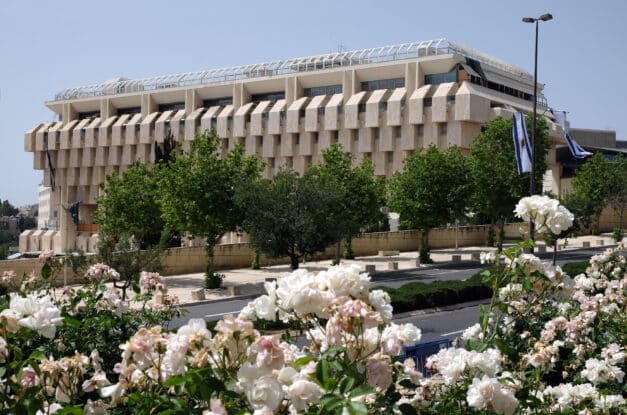
Israel’s first interest-rate cut in nearly two years marks an important shift in monetary policy, driven by slowing inflation, a strengthening shekel, and signs of economic recovery. The reduction from 4.5% to 4.25% offers modest relief to mortgage holders and signals a gradual move toward normalization after a prolonged period of high rates. Yet the Bank of Israel is emphasizing caution: future decisions will depend on inflation trends, fiscal discipline, and geopolitical stability, and no rapid easing cycle is expected. As the local market continues to stabilize and eventually rebound, some of the favorable terms, softer pricing, and unique opportunities available today may become less accessible.
For the first time since January 2024, the Bank of Israel has lowered the benchmark interest rate, reducing it by a quarter point from 4.5% to 4.25%. The change takes effect on Thursday, allowing banks time to update their systems and implement the revised mortgage rates. The move follows nearly two years of holding policy steady and comes at a moment when inflation has stabilized, the shekel is strengthening, and signs of economic recovery are becoming more visible. While the decision was widely expected, the message that accompanied it was equally important: the Bank is not promising a rapid sequence of cuts and is approaching the months ahead with caution.
The rate cut was made possible by a noticeable moderation in inflation, which now stands at 2.5% in the last two consumer index readings—comfortably within the government’s target range. Over the past four months, inflation has averaged just 1.8% on an annualized basis, suggesting that the sharp price pressures of 2022–2023 have eased significantly. The shekel’s appreciation has also played a key role. Since the previous rate decision, the currency has strengthened by 1.3% against the dollar and close to 10% over the past six months, offering additional confidence that imported goods will not reignite inflation.
The move also reflects global conditions as interest rates in the U.S. and Europe have already been reduced several times this year, leaving Israel as one of the only Western economies that had not eased policy since early 2024.

At the same time, the Israeli economy is recovering faster than many expected. GDP surged by 12.4% on an annualized basis in the third quarter, and recent data on credit card spending, business sentiment, high-tech fundraising, and consumer confidence all point toward renewed activity. Financial markets have also stabilized, with rising stock prices, declining risk premiums, and relatively strong credit performance across the business sector. All these indicators helped create an environment where the Bank felt comfortable making its first move toward easing.
Despite this positive backdrop, the Bank emphasized that the immediate impact on mortgage payments will be modest. According to calculations by the Israeli Mortgage Advisers Association, a typical household will save around 70 shekels per month, and roughly 20,000 shekels over the life of a standard mortgage in Israel, while independent mortgage specialists note that for long, 25-year terms, total savings may even reach as high as 39,000 shekels, but this remains limited relief within the broader cost structure of home financing.
Although many in the real estate sector hoped that a November rate cut would mark the beginning of an accelerated easing cycle, the Bank of Israel is intentionally tempering expectations. In an interview with Globes, Governor Amir Yaron stressed that the economic conditions justified a cut “this time,” emphasizing that future decisions will be made carefully and gradually. He highlighted that inflation, geopolitical uncertainty, fiscal policy decisions, and the pace of economic recovery will all play a role in determining the trajectory ahead. Analysts at Bank Hapoalim and Mizrahi-Tefahot echoed this sentiment, predicting that the next rate decision in January is likely to leave the interest rate unchanged. Even the Bank’s own research department had forecast a gradual path, expecting rates to reach around 3.75% sometime next year—not a dramatic shift, but a slow, measured adjustment.
The economy needs security, but security also needs the economy
Professor Amir Yaron—Governor, The Bank of Israel,
The Bank also used this moment to send a subtle yet pointed message to the government. The Monetary Committee noted that a 2026 state budget reflecting a declining debt-to-GDP ratio would strengthen market confidence and help stabilize bond yields and inflation expectations. At the same time, the debate over defense spending is intensifying, as the military requests significant increases and policymakers grapple with the challenge of balancing urgent security needs with long-term fiscal discipline.
For buyers, the broader picture is one of transition. The market is not in crisis, nor is it in full recovery. Instead, it is moving through the early stages of normalization after a period of exceptional volatility. The rate cut is a meaningful step in that direction, but it will take time for its effects to filter through the system. Borrowing conditions may improve gradually through 2026, especially if the Bank continues to ease policy at a careful pace. Prices in many regions remain softer than in previous years, creating opportunities for buyers who had previously stepped aside. These windows of opportunity may narrow as the local market stabilizes and demand bounces back. The strengthening shekel, however, may influence timing decisions for those converting foreign currency.
The Buyitinisrael Editorial team is made up of industry experts, journalists, researchers, editors, and translators working together to deliver reliable, up-to-date information about the Israeli property market — all in English. With a strong focus on transparency and accessibility, our goal is to empower English-speaking buyers by helping them understand the market and navigate the real estate process with clarity and confidence.
For inquiries, email [email protected].