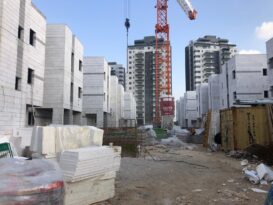
Apartment prices in March–April 2026 returned to a downward trend, falling approximately 0.3% — following a similarly sized increase the month prior. This is according to the apartment price index published Monday evening by the Central Bureau of Statistics (CBS). When comparing transactions carried out in the current period against the same period last year (March–April 2026 vs. March–April 2025), apartment prices were found to have declined by 1.3%.
By Nimrod Bossu, Nadlan Center
In terms of price changes by district, the Jerusalem District recorded a sharp price decline of 2% from March–April 2026 compared to February–March 2026. The Haifa District saw a similar drop of 1.9%, while the South District declined by 0.9%. Tel Aviv District, by contrast, posted a 0.7% increase.
In the year-over-year comparison, the Central District showed the steepest decline at 3.1%, followed by Tel Aviv (1.9%), and Haifa and South districts (1.1% each). Price increases were recorded in the North District (2.5%) and Jerusalem District (1.7%).

New apartment prices fell 0.1% in March–April. Among all new apartment transactions, the share of government-subsidized deals rose from 28.8% in the prior period (February–March 2026) to 38.7% in the current period. “Our analysis shows that the new apartment price index, excluding government-supported transactions, declined by 0.7%,” the CBS noted. In year-over-year terms, new apartment prices fell 3.9%.
Rental Prices Surge Nearly 7% Upon Tenant Turnover
The Consumer Price Index fell 0.3% in May 2026 compared to April 2026. Over the past twelve months (May 2026 vs. May 2025), the CPI rose 1.9%.
An analysis of rental prices by tenant group — included within the CPI — found that rents for tenants who renewed their leases rose 2.5%, while rents for new tenants (units in the sample where a tenant change occurred) surged 6.8%. “It should be noted that these rate-of-change figures represent an approximation of the annual rate of change in rent for these groups — since rent does not change for the vast majority of tenants during the year, given that they are under lease agreements in which the monthly rent is fixed, typically without indexation mechanisms,” the CBS stated.
Construction Input Costs Rise 3.5% Over the Year
The residential construction input price index rose 0.6% in May 2026, reaching 103.4 points compared to 102.8 points the prior month (base: July 2025 = 100.0 points). The wage index for workers employed in the construction sector rose 1.1% in May 2026. The residential construction input price index excluding wages rose 0.2%.
Over the past twelve months (May 2026 vs. May 2025), the residential construction input price index rose 3.5%, driven by a 5.3% increase in labor costs.
The materials and products price index rose 0.3% in May 2026. Among individual components, notable increases were recorded in ready-mix concrete (1.3%), sewage and drainage systems and various materials and products (1.1% each), and safe room products (1.0%). Declines were recorded in other concrete products (2.2%), construction steel (1.2%), and mesh and cages (1.0%).

Nadlan Center is Israel’s leading real estate news and knowledge platform in Hebrew, created for industry professionals. Founded by experts in the field, it delivers in-depth, up-to-date coverage on urban renewal, planning and construction, taxation, and housing policy — tailored to the needs of developers, investors, planners, and financiers. In addition to its widely read news content, Nadlan Center hosts major industry events, professional conferences, and training programs that support the growth and development of the Israeli real estate sector.
Learn more: https://www.nadlancenter.co.il