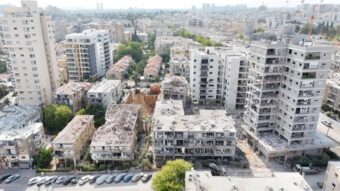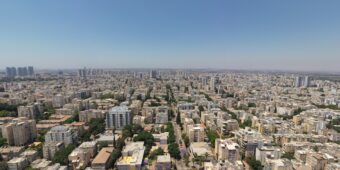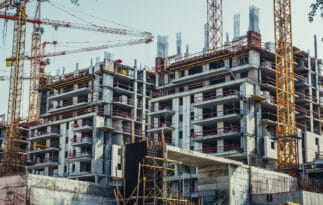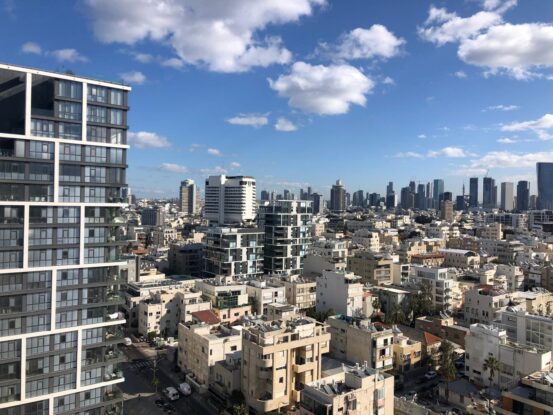
While the number of homes in Israel continues to rise at a modest pace, regional and structural disparities are becoming more pronounced. The center and Tel Aviv account for roughly half of all apartments, cities with younger populations face exceptional overcrowding, and peripheral areas remain dominated by low-rise construction. The report underscores that expanding supply alone does not solve the housing crisis, and that apartment size and construction mix must be better tailored to local needs.
By Li Saadon, Nadlan Center
Israel has reached a historic milestone in its housing market. According to the Central Bureau of Statistics’ 2025 report on dwellings and buildings, published today (Monday), the total number of residential apartments in Israel has surpassed 3 million for the first time. Behind this impressive headline, however, lies a far more complex picture marked by moderate growth and clear regional disparities.
By mid-2025, Israel’s housing stock stood at approximately 3.02 million apartments, an increase of just 56,000 units compared with the previous year, representing annual growth of 1.9%. This continues a long-term upward trend, but at a pace that falls short of keeping up with population growth in many areas. Over the past decade, around 452,000 apartments were added, a cumulative increase of about 19.6%, yet this figure alone does not tell the full story of Israel’s housing supply.

The geographic distribution of apartments highlights the gaps. The Central District accounts for 24.6% of all apartments, while the Tel Aviv District accounts for 19.5%, together accounting for nearly half of Israel’s housing supply. By contrast, Judea and Samaria have the smallest share, with just 3.2% of apartments. In Tel Aviv, the share of apartments exceeds the district’s share of the national population—19.5% of apartments compared with 15.1% of residents. A similar pattern appears in the Haifa District, which accounts for 13.4% of apartments and 11.6% of the population.
In contrast, the Jerusalem, Southern, Northern, and Judea and Samaria districts have a higher share of the population than of apartments. The explanation lies partly in household composition: Tel Aviv and Haifa tend to have smaller households, reflecting an older age structure relative to other regions, which directly affects Israel’s housing supply needs.
Additional data reveal sharp disparities in housing density among cities with populations exceeding 50,000. Cities such as Beitar Illit, Modi’in Illit, Elad, Beit Shemesh, Bnei Brak, Nazareth, and Jerusalem have exceptionally high ratios of residents per apartment—between 4 and 8 people on average. These cities are characterized by young populations, large households, and a high proportion of families with five or more members, placing unique pressure on Israel’s housing supply.
By contrast, cities such as Ramat Gan, Haifa, Givatayim, and Tel Aviv–Yafo have very low ratios of residents to apartments, averaging around two people per unit. This reflects a high prevalence of single-person households and a relatively low number of children. Sharp differences also emerge in construction typology across major cities. Ashdod and Bat Yam lead in high-density construction, with some of the highest shares in the country of buildings with 41 or more apartments—about 9.1% in Bat Yam and 9.0% in Ashdod. Netanya also stands out with around 5.1%, followed by Tel Aviv–Yafo at 4.2% and Ashkelon at 3.8%.
Bat Yam is particularly notable for its mid-range, dense construction as well. Approximately 15% of its buildings contain 31–40 apartments, and another 18% include 21–30 apartments, underscoring the city’s dense urban character. Bnei Brak also shows an unusually high concentration of dense housing, but of a different type: about 38% of its buildings contain 11–20 apartments, the highest rate in this category nationwide, followed by Bat Yam with around 29%. This reflects dense, non-tower construction suited to an older urban fabric and large households—another facet of Israel’s housing supply.
On the other end of the spectrum, cities such as Be’er Sheva and Ashkelon rely heavily on low-rise construction. Buildings with one to two apartments account for 70.7% of structures in Be’er Sheva and 68.5% in Ashkelon. High shares of low-rise buildings are also found in Herzliya and Hadera, where more than half of all structures contain just one or two apartments. In contrast, Bat Yam at 4.4% and Bnei Brak at 7% have particularly low proportions of small buildings. Tel Aviv–Yafo presents a more complex and diverse picture: about 25% of buildings contain one to two apartments, alongside roughly 20% with 6–10 apartments and around 23% with 11–20 apartments.
Israel’s housing market continues to expand, but at a moderate pace that does not resolve ongoing housing pressures. The gaps between regions and population groups are clearly evident in the data. The central question that emerges is whether increasing the sheer number of apartments can truly address the housing crisis, or whether a deeper shift in planning philosophy is required—one that focuses not only on how many homes are built, but also where they are built, for whom, and with what apartment sizes. Smaller units may be needed in cities with shrinking households, while larger apartments are essential in areas characterized by young, densely populated communities to ensure a sustainable housing supply.

Nadlan Center is Israel’s leading real estate news and knowledge platform in Hebrew, created for industry professionals. Founded by experts in the field, it delivers in-depth, up-to-date coverage on urban renewal, planning and construction, taxation, and housing policy — tailored to the needs of developers, investors, planners, and financiers. In addition to its widely read news content, Nadlan Center hosts major industry events, professional conferences, and training programs that support the growth and development of the Israeli real estate sector.
Learn more: https://www.nadlancenter.co.il