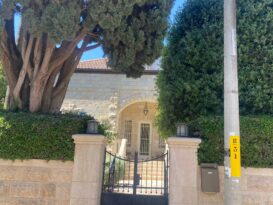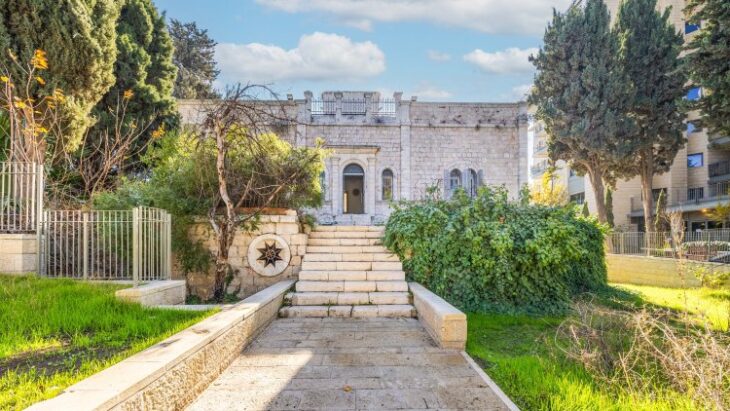
Bishop’s House, a Jerusalem mansion built in 1876 by a missionary society, changed hands several times before its current purchase by a company owned by American Jewish foreign residents. British press baron Robert Maxwell once lived there. The property includes a two-story stone house and a rooftop terrace overlooking the Old City, with 630 sqm of built space on a one-dunam plot.
By Ranit Nahum-Halevi, Nadlan Center
One of the most intriguing deals in Jerusalem’s luxury real estate market was recently completed: Bishop’s House, a historic Jerusalem mansion at 25 HaNevi’im Street, which was offered for sale last February for NIS 54 million, has sold for NIS 50 million. The buyer is a company established by foreign residents from the U.S., who plan to make aliyah to Israel at a later stage.
This represents a reduction of NIS 4 million, about 7.4% of the asking price, a relatively moderate gap that is not unusual in luxury real estate negotiations, particularly for a unique historic property for which direct comparables are hard to find. The deal was carried out through the brokerage Prosperity Real Estate, led by Ronit and Tomer Dweck. The question of VAT also came into play: although the property was offered mainly to private buyers throughout the marketing period, it was ultimately sold to a company, which led to a requirement to add VAT to the transaction price, bringing the total consideration to approximately NIS 59 million.

Bishop’s House was built in 1876 during Ottoman rule and is considered one of the few historic stone estates in central Jerusalem that remain almost entirely intact. It sits on a one-dunam plot and includes a two-story stone building designated for preservation, a spacious inner courtyard, and a rooftop terrace overlooking the Old City, the Temple Mount and the Mountains of Moab. According to figures provided as part of the deal, the building’s built area is approximately 630 sqm.
From Maxwell to Azorim
The Jerusalem mansion has an extraordinary history, including a connection to one of the most famous and controversial families in the British business world. In the 1970s, the family of British-Jewish media mogul Robert Maxwell, the former controlling shareholder of Maariv, lived there.
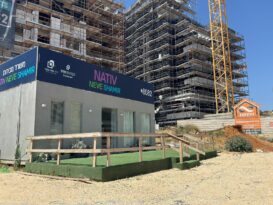
But the connection between Bishop’s House and the local real estate market does not end with its history. Over the years, the property was sold to another Jewish buyer of English origin, although the family never lived there. Instead, it was leased to Azorim, which ran the sales office for the adjacent residential project from the building until about three years ago. The owners of the Bishop’s House land also entered into a combination deal with Azorim, which developed a new residential project behind the historic building on a compound originally covering about 5 dunams. The project includes 116 housing units and approximately 4,000 sqm of built space. Now, with the completion of the current deal, the property has changed hands once again.
The deal is also noteworthy given price levels in the surrounding luxury market. At the end of 2025, an apartment in the project Azorim built behind Bishop’s House sold at a price reflecting about NIS 70,000 per sqm. The sale price of the historic Jerusalem mansion, about NIS 50 million, works out to roughly NIS 79,000 per sqm based on the stated built area. However, the comparison is not direct, since the price also covers a private plot, courtyard and roof areas, as well as the building’s architectural value and the preservation restrictions that apply to it.
A Glassware Factory in World War II
Bishop’s House was established in 1876 by the London Society for Promoting Christianity Amongst the Jews and initially served representatives of the Anglican mission in Jerusalem. Between 1878 and 1902, Reverend Arthur Hastings Kelk lived there, which gave the building its other name, “Kelk House.”
The building was erected at a time when Jerusalem was beginning to expand beyond the walls of the Old City. It was surrounded by a high stone wall and included a spacious courtyard, horse stables, impressive staircases, and lavish reception rooms. Its massive walls, up to one and a half meters thick, and its vaulted ceilings, rising to about 5.2 meters, reflect the construction methods of the late 19th century.
During World War II, in 1944, the building took on a new purpose when the Phoenicia company set up a glassware factory there, in response to a shortage of medical laboratory glassware in Mandatory Palestine. After the War of Independence, when the surrounding area became part of the border zone of divided Jerusalem, the building served as a kindergarten run by missionary sisters from Finland. Later, some of its spaces were used as the home and studio of a Jerusalem artist.
Over the years, the property passed through various owners, and development plans proposed for the compound raised questions about the future of the historic house. Ultimately, its architectural and historical importance was recognized, and the building was designated for preservation. Despite the changes it underwent, it has retained many of its original features, including its thick stone walls, high ceilings, historic staircases, and a rooftop room known as the “Prophet’s Room,” which offers a panoramic view of the Old City.
From an economic standpoint, buying Bishop’s House is different from an ordinary residential transaction. It is a historic property designated for preservation, which limits the options for alteration and development and may require significant investment in restoration and maintenance. On the other hand, the supply of historic estates that remain intact in central Jerusalem is limited.
According to information released after the deal closed, the Jerusalem mansion is expected to undergo preservation and restoration. Ronit and Tomer Dweck, who led the deal on behalf of Prosperity Real Estate, said: “There are properties you sell, and there are properties where you feel privileged to be part of their story. Bishop’s House is exactly that kind of property. The house, built 150 years ago as part of Christian missionary activity and witness to extraordinary chapters of history, ultimately passed into Jewish hands and is now entering a new era of preservation and renewal. For us, beyond the complexity of the deal and its economic significance, what makes this moment truly meaningful is knowing that we were privileged to be another link in the remarkable story of this place.”

Nadlan Center is Israel’s leading real estate news and knowledge platform in Hebrew, created for industry professionals. Founded by experts in the field, it delivers in-depth, up-to-date coverage on urban renewal, planning and construction, taxation, and housing policy — tailored to the needs of developers, investors, planners, and financiers. In addition to its widely read news content, Nadlan Center hosts major industry events, professional conferences, and training programs that support the growth and development of the Israeli real estate sector.
Learn more: https://www.nadlancenter.co.il