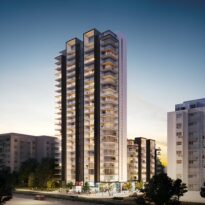
The Jerusalem District Planning and Building Committee meets today to discuss the Talpiot urban renewal plan for the Yad Harutzim compound. Among the business owners facing eviction are people who were previously moved out of the Mamilla compound and given properties in Talpiot. “There are businesses here that have operated for 20 to 40 years, and now they want to take everything from us.”
By Ranit Nahum-Halevy, Nadlan Center
A fierce battle is unfolding in Jerusalem ahead of a hearing expected today (Tuesday) at the District Planning and Building Committee on the Talpiot urban renewal plan known as Talpiot SKY, which is being advanced at 14–16 Yad Harutzim Street and 37 Pierre Koenig Street.
Behind the massive plan lies a long-established commercial compound housing about 200 businesses across a range of sectors, including garages, carpentry shops, printing houses, and stores selling building materials, ceramics, and paint. According to the rights holders’ objection, the companies that own properties in the compound include Beit Hatzaatzua, Maor Wallach Printing, Hachaver Garage, Hamelacha Carpentry, and A.B. Ceramics. In total, the compound comprises 253 commercial units in three buildings.

Yet behind the planning dispute lies an unusual story. Some of the business owners were previously forced out of Jerusalem’s Mamilla compound as part of the area’s development and the construction of Alfred Akirov’s luxury project, and in exchange received properties in Talpiot, where they rebuilt their businesses. Now, decades after being uprooted, they fear they will have to move again, with no guarantee that they can keep operating or return to the compound once the project is complete. Such an eviction, they say, could bring not only relocation costs but also lost income, damage to their reputation, and the loss of customers.
According to the rights holders’ representatives, despite repeated appeals to the municipality and planning institutions, they were not invited to the District Committee’s upcoming hearing. “We want to show the committee everything that has been done wrong to date. They present it as though the developer has the consent of 70% of the area, but about 80% of the rights holders have signed against the plan. No one is willing to sit down with us and look into the matter.”
Not Holdout Tenants but Business Owners
At the center of the dispute is Al Gagot Talpiot Ltd., which bought rights to the rooftops of three buildings in the compound about seven years ago and is now promoting a plan to demolish them and build residential, commercial, and employment towers. The property owners oppose the plan in its current form, arguing that it is being advanced without giving them any real opportunity to influence the future of their properties and businesses.
Al Gagot Talpiot Ltd., whose directors include businessmen Benny Babai and Yehiel David Potash, was incorporated in October 2018. In July 2019, less than a year after its establishment, the company purchased rights to three rooftops in the compound from the Jerusalem Economic Corporation, for about NIS 15 million per rooftop, for a total of some NIS 45 million.
The Talpiot urban renewal plan covers about 29 dunams between Poalei Tzedek, Pierre Koenig, and Yad Harutzim streets in Talpiot. It calls for demolishing the existing buildings and building four 50-story residential towers with 1,366 apartments, plus a 40-story employment and commercial tower. In June 2026, the Jerusalem Local Committee recommended that the District Committee deposit the plan for public review. However, at a hearing held in July, the District Committee refrained from deciding on deposit and called for deeper engagement with the rights holders, with the plan to be discussed again in about three months.
In a letter sent on September 15, 2026, to Mayor Moshe Lion and City Engineer Yoel Even through attorney Zvi Odem of Herzog, Fox & Neeman, who represents the three representative bodies of the three compounds in the plan, together comprising about 200 business owners, the house committees of the three buildings announced their opposition to the plan. They demanded that the municipality withdraw its signature as the plan’s submitting party. According to the property owners, the meetings held so far produced no substantive changes to the plan and no solutions to their needs; “rather, only the developer’s plan was presented, while ignoring the ownership situation on the ground.”
Another letter, sent to the District Committee in November 2025, claimed that the plan is being advanced without the required property-owner consent. According to the rights holders, instead of halting the process until landowner consent was clarified, the Local Committee decided to join as a submitter of the plan.
The rights holders argue that this allows a private developer to advance a major Talpiot urban renewal plan over the property owners’ objections. They say the Local Committee made its September 10, 2025, decision despite being told that consent was lacking. They have also asked the District Committee to use its authority under Section 28 of the Planning and Building Law and order a halt to the plan’s advancement.
The rights holders therefore warn against advancing a plan that would evict active businesses without giving them a real chance to influence the future of their properties and the compensation they will receive. “Decades of work are going down the drain,” says attorney Zvi Odem of Herzog Fox & Neeman, who represents the owners’ representatives of the three parcels in the compound. “Already today, merely because the plan is being advanced, tenants are leaving, and business owners are freezing investments. And the way this is happening is no less worrying: the law states that a developer cannot advance a plan in a jointly owned building without a majority of the owners. Here, when the developer didn’t have a majority, the Local Committee stepped into its shoes and became the plan’s submitter. If this goes through, every developer who failed to convince the owners will know they can bypass them through the municipality. It’s a dangerous precedent for every property owner in Israel.”
Not a Rubber Stamp
The rights holders further claim that they never chose the developer advancing the project, Al Gagot Talpiot Ltd. In objection documents signed by rights holders in all three buildings, they declare that they did not give their consent to the developer. They demand that the entity to advance the compound be selected through a competitive developer tender, with a lawyer and a project organizer acting on behalf of the property owners.
The rights holders do not necessarily rule out future Talpiot urban renewal at the compound. However, they argue that a particular developer should not be allowed to set the project’s framework and economic terms in advance, leaving landowners to respond to a plan that has already been drawn up.
Another claim concerns the land reparcellation (consolidation and division) procedures. According to the rights holders, the plan is moving ahead without the required allocation and balancing tables being presented to them, and without a detailed examination of their rights and the value of the commercial properties they own. They add that the plan’s appraiser never met with them to assess the properties or the businesses operating there.
The dispute is compounded by a significant economic gap between two appraisal opinions prepared for the project. An opinion prepared in August 2025 for the developer by the appraisal firm Shaul Rosenberg & Co. estimated the developer’s profit at about NIS 614 million, reflecting a return of about 16.4% on costs. By contrast, an economic review conducted in June 2026 for the rights holders’ representatives by the appraisal firm of Israel Yaakov estimated the profit at about NIS 1.29 billion, reflecting a return of about 35.6%. That amounts to a gap of about NIS 674 million between the estimates, which were prepared at different times and based on different assumptions.
According to the review commissioned by the rights holders, the compensation offered to property owners who choose the residential option could therefore be increased from a ratio of 0.8 new square meters per existing square meter to 1.1, while still leaving the developer with a profit of about 19.7% on costs.
“They keep telling us it’s only planning and that no one is being evicted yet. But once a statutory plan is approved, it creates a new planning reality that will be very difficult to change,” says one of the owners. “We are not opposed to urban renewal. We oppose planning on our properties without talking to us and without our consent. There are people here who were already evicted once from Mamilla and started over in Talpiot.”
“There are businesses here that have been operating for 20, 30, and 40 years. These aren’t empty buildings that can be erased on paper. These are workplaces, families, and the livelihoods of hundreds of people,” says a source within the business owners’ representatives. “We are demanding something basic: that they talk to us before deciding the future of our properties.”
The Jerusalem Municipality said in response: “The Jerusalem Municipality attaches great importance to advancing urban renewal in the Talpiot employment area, in line with the city’s planning policy and the master plan set for the area. The compound in question includes old buildings which, in the view of the municipality’s professional staff, should be renewed through modern, high-quality, mixed-use construction, while taking advantage of the access to the light rail line. The Local Committee joined as the plan’s submitter based on a professional planning perspective and in accordance with municipal policy, and this does not constitute taking a position in the disputes between the rights holders in the compound. The municipality is aware of the disputes between the rights holders, and the claims relating to them will be examined in the appropriate proceedings, in accordance with the law.”
The Jerusalem District Planning and Building Committee said: “The Talpiot SKY plan is pioneering in its scale in the renewing Talpiot district, and proposes the redevelopment of a long-established industrial and crafts compound covering about 30 dunams. The plan makes a significant public contribution for all city residents, offering a new school complex, large public plazas, and a new culture and sports center next to the light rail on Pierre Koenig Boulevard, alongside additional housing units of various sizes. Contrary to the claims, the plan does not harm any party’s rights; rather, it safeguards all owners’ rights and their equal allocation, as is customary in reparcellation plans. The District Committee held a deposit hearing in July of this year, and in light of claims by some of the parties, decided that the plan’s developer would hold a meeting to present the plan to the various owners and engage in dialogue with them.”

Nadlan Center is Israel’s leading real estate news and knowledge platform in Hebrew, created for industry professionals. Founded by experts in the field, it delivers in-depth, up-to-date coverage on urban renewal, planning and construction, taxation, and housing policy — tailored to the needs of developers, investors, planners, and financiers. In addition to its widely read news content, Nadlan Center hosts major industry events, professional conferences, and training programs that support the growth and development of the Israeli real estate sector.
Learn more: https://www.nadlancenter.co.il