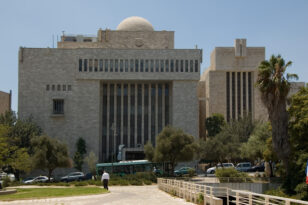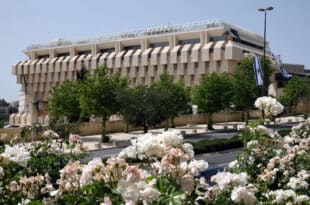
The Monetary Committee of the Bank of Israel decided today (Monday) to leave the interest rate unchanged, at 4.5%, its level since January 2024. This is contrary to some market assessments that, in light of the strengthening shekel and easing inflation, a rate cut would be announced this time.
The last time the interest rate was reduced — by 0.25 percentage points from 4.75% to 4.5% — was in January 2024, shortly after the outbreak of the Iron Swords war. Before today’s decision, expectations in the market were that, given the stronger shekel and slowdown in inflation, the Monetary Committee would lower the rate. In the Bank’s statement, however, it was explained that the decision was taken “against the backdrop of escalating fighting in Gaza and worsening international sentiment toward Israel, with geopolitical uncertainty remaining high.”
The Bank of Israel further noted that the pace of inflation over the past 12 months declined slightly, standing at 2.9%, at the upper bound of the target range. In the coming months, inflation is expected to remain near the upper bound, and even exceed it, before beginning to moderate in early 2026. Economic activity in Israel has recovered following Operation Rising Lion.
With respect to the construction sector, the Bank wrote that “activity in construction remains significant, with housing starts and building permits continuing to rise and remaining high in annual terms. At the same time, the decline in the number of housing transactions continued, and the annual rate of increase in home prices has moderated.” The Bank added that “against the backdrop of geopolitical uncertainty, the path of the interest rate will be determined in accordance with inflation converging toward its target, stability in financial markets, economic activity, and fiscal policy.”

From the Mortgage Advisors Association came the response that “the Bank of Israel’s decision to leave the interest rate unchanged reflects the balance of monetary considerations and the macroeconomic picture of Israel’s economy, but it comes against a particularly troubling warning sign: mortgage arrears have, for the first time, crossed the threshold of 4 billion shekels. This figure is not just dry statistics, but a clear signal of unprecedented distress among Israeli households. Behind these numbers are families struggling, unsuccessfully, to meet their monthly obligations. The harsh economic reality — a combination of high interest rates, record cost of living, and record housing prices — is creating a perfect storm for borrowers.”
“The deep failure that perpetuates this reality lies in government housing policy, which allows market forces to dictate instead of setting long-term goals to reduce prices and working to achieve them. In practice, families are forced to take on ever-larger mortgages, and the result is evident in the arrears data. As noted, the Bank of Israel is acting with great caution in the face of a complex geopolitical reality of prolonged war, whose consequences spill over into the economic arena as well, but one must not turn a blind eye. The rise in arrears is pushing parts of the public to seek financing solutions outside the banking system and take on further commitments in a less regulated environment. This is a moment of truth for decision-makers.”
Nofar Yaakov, Chairwoman of the Mortgage Advisors Association, added: “As those who work on the ground and feel the pulse of households across the country — especially the middle class — we see the Israeli public at the edge of its purchasing capacity, the growing arrears, and the changes in the housing market that sharpen the dramatic importance of advancing legislation to regulate the profession as soon as possible. There is an urgent need to strengthen the professional frameworks that protect the public and help it manage efficiently and transparently in the financial jungle, with reliable and supervised professional advice.”
According to Ofer Aharonovitz, Head of the Mortgage Division at Eldar Mortgages: “The Bank of Israel decided to keep the monetary interest rate at 4.5%, maintaining a cautious and balanced policy in the shadow of the war. The decision is based on three main considerations. First — combating inflation and anchoring expectations: although inflation is close to the target, the Bank is unwilling to take risks. Keeping the rate high is intended to ensure price stability and anchor inflation expectations within the government’s target. Second — stabilizing the shekel amid the war: security and fiscal uncertainty require a stable rate to support the shekel’s exchange rate. A cut could have caused depreciation, raising import prices and accelerating inflation. Third — a cautious approach despite slower growth: although economic activity has weakened somewhat due to the war, the Bank prefers to prioritize managing inflationary risks arising from increased government spending and the war’s long-term effects. In short, the interest rate remains at its current level as an ‘economic safety cushion,’ preferring stability over aggressive monetary easing.”
Gilad Oren, CEO of Matzlawi Construction, stated that “the decision to leave the interest rate unchanged is disappointing, especially in light of the great challenges facing the real estate market. Even if the economic considerations are understood, the failure to cut rates continues to burden homebuyers as well as developers. In urban renewal projects, particularly in the periphery, the level of risk remains high, and the lack of monetary relief continues to delay important projects for renewing old urban fabrics. We hope the Bank will reconsider its policy in the coming months in view of field indicators.”
Nimrod Tzvik, CEO of Marom 360, which markets real estate for developers and clients, said: “In light of the Governor’s decision not to cut rates even now, it must be said clearly that the public is already collapsing under the burden. While inflation has stabilized within the framework set, the decision not to ease the burden on citizens and homebuyers is nothing short of an abuse of the public. This decision is a direct blow to citizens and a move that weighs on all of us. It must be said plainly: the time has come to consider the broader public and how to alleviate its burden in these times. In the current situation, with inflation already close to the upper bound of the target, the public expects genuine relief and a shift in economic thinking.”

Nadlan Center is Israel’s leading real estate news and knowledge platform in Hebrew, created for industry professionals. Founded by experts in the field, it delivers in-depth, up-to-date coverage on urban renewal, planning and construction, taxation, and housing policy — tailored to the needs of developers, investors, planners, and financiers. In addition to its widely read news content, Nadlan Center hosts major industry events, professional conferences, and training programs that support the growth and development of the Israeli real estate sector.
Learn more: https://www.nadlancenter.co.il