Israel’s housing market is in its longest run of annual price declines in a decade. The latest Central Bureau of Statistics data for July–August 2026 shows prices down 0.6% from the previous two months and 1.8% from a year earlier, with every district lower year on year. Rents and construction costs are still climbing, and inflation is easing. Below are the figures and what they mean for anyone buying, whether from Israel or overseas.
The Central Bureau of Statistics (CBS) reported on this evening (Thursday) that its national apartment price index fell 0.6% in July–August 2026 compared with June–July. The two readings before that each showed a gain of only 0.1%, which some read as a sign the market had bottomed out. The new figure suggests it had not.
Prices are down 1.8% compared with July–August 2025. The CBS also put the decline in historical context. Annual price declines have happened only three times in the past ten years: for three quarters in 2018, briefly in the second half of 2023, and now. The current period is already the longest of the three. For a market where rising prices were taken for granted for most of the last decade, that is a real change. It is still a slowdown, though, not a collapse.
The Regional Scorecard
National averages hide large local differences. Here is how each district has moved:

| District | Annual change | Latest two-month change |
|---|---|---|
| Center | −2.7% | −0.7% |
| Tel Aviv | −1.9% | −0.9% |
| South | −1.5% | −0.1% |
| Haifa | −1.4% | +0.4% |
| North | −0.8% | −1.5% |
| Jerusalem | −0.2% | −0.3% |
Center and Tel Aviv are leading the decline. The most expensive parts of the country, with the most investor activity, have given back the most. In these markets, sellers who listed at last year’s prices are increasingly having to negotiate.
Jerusalem holds steady. A 0.2% annual decline is effectively flat. Demand in the capital comes from a mix of local families, religious communities, and buyers from abroad who want to be in Jerusalem specifically. That base doesn’t shift much when the wider economy does. Expect stable prices there, not discounts.
The North and Haifa are moving in opposite directions. The North recorded the sharpest two-month drop of any district, while Haifa was the only one to rise. Both are still far cheaper than the center, and that price gap keeps drawing buyers who are looking for value or rental yield.
New Construction: Far Weaker Than the Headline
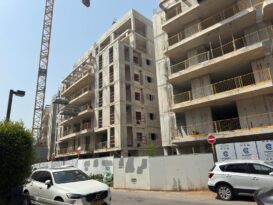
The CBS index for new builds fell 0.4%, both compared with the previous period and year on year. The more important figure is a different one. When Government-subsidized purchases were excluded, new-apartment prices fell 0.8%, twice the headline figure. In other words, the open market for new construction, where private buyers shop, is weaker than the official numbers suggest.
Developers with unsold units on the open market are generally more willing to negotiate on:
- Smaller down payments and longer payment schedules
- Deferred-payment plans that push most of the price toward completion
- Upgraded finishes, or parking and storage included in the price
- Help with legal or other transaction costs
However, while these concessions don’t show up in price indices, they can change the real cost of a purchase considerably.
Five Years in Perspective
Since July–August 2021, overall apartment prices have risen 26.8% and new-apartment prices 24.3%, according to the CBS. A decline of under 2% after a rise of more than a quarter is a pause, not a reversal. The long-term drivers of Israeli housing demand haven’t changed: high population growth, limited land, and demand from abroad.
Rents Keep Climbing
Rents are moving the opposite way from purchase prices. The CBS found that tenants renewing their leases paid 2.4% more, while new tenants paid 5.3% more. Most Israeli leases fix the rent for the full term, so these figures are close to the actual annual increase.
This matters for investors and those making Aliyah. Lower purchase prices combined with rising rents improve rental yields, especially in the center, where prices have fallen most. Families moving to Israel usually rent for a while first, and that is now more expensive. For some, buying earlier may cost less overall than a long rental.
Building Costs Set a Floor
Anyone waiting for a sharp correction should look at developers’ costs. The CBS index of residential construction costs rose 0.1% in September and 3.6% over twelve months. Labor is the main driver: construction wages are up 5.3% on the year, including a further 0.2% rise in September. Building materials were mixed in September. Rebar steel rose 3.1% and steel mesh and cages 3.0%, while plaster fell 2.9% and ready-mix concrete fell 0.9%. The overall materials index edged up 0.2%. When costs rise while sale prices fall, developers’ margins shrink, and that limits how far new-build prices can drop. It helps explain why this downturn has been gradual rather than sharp.
Inflation and Interest Rates
The housing data came out alongside the September Consumer Price Index, which fell 0.5% for the month. Annual inflation now stands at 1.6%, comfortably within the Bank of Israel’s target range. With inflation contained and housing cooling, the central bank has room to cut interest rates, and its next decision is due next week. Lower rates would make mortgages cheaper, but they would also bring hesitant buyers back into the market. In Israel, that has historically been how periods of weak prices end. Buyers who are ready before rates fall tend to be in the strongest negotiating position.
The Bottom Line
The Israel housing market is cooler than it has been in years. Prices are below last year’s levels in every district, developers are motivated to sell, inflation is under control, and a rate cut may be coming. Rents are rising, and building costs are still climbing, though, and that limits how much further prices are likely to fall. For buyers in Israel or abroad, this is a market that rewards preparation: get mortgage pre-approval in place, understand your tax position, and narrow down your neighborhoods.

Debbie Goldfischer is the founder and CEO of Buyitinisrael and the host of the Israel Real Estate Podcast: On The House. A prominent figure in real estate since 2004, Debbie has spent two decades helping foreign buyers successfully purchase homes in Israel. Seeing a lack of reliable, English-language resources for navigating the Israeli property market, she launched Buyitinisrael.com in 2020. In addition to leading the platform, Debbie is available to personally assist you in finding the right property—whether new or resale—anywhere in Israel.
To connect with Debbie, email [email protected].