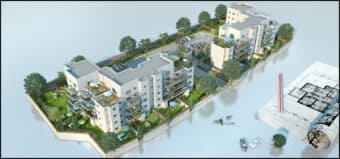
With little open land left and a fast-growing population, Israel is increasingly rebuilding its cities from within. Urban renewal now accounts for about half of all new housing approved in Israel’s planning system and more than a quarter of construction starts, and it will shape Israel’s cities for decades. Here is what urban renewal is, why it matters, how long it really takes, and what it means for owners of older apartments, buyers of new homes, and investors.
Drive through almost any established Israeli city today and you will see the same scene repeated: a tired four-story block from the 1960s, its balconies enclosed and its stairwell worn, standing beside a gleaming new tower that rose on the site of a building just like it. That transformation is urban renewal, and it has quietly become one of the most important forces in Israeli real estate. Urban renewal projects now supply a large and growing share of the country’s new homes, and they are changing how Israelis live, where they buy and what they pay.
For foreigners, understanding urban renewal in Israel is no longer optional. Whether you own an older apartment, plan to buy a new one, or are thinking of investing, it is likely to affect you directly.
Why Israel Has to Build Upward
Israel’s housing challenge comes down to simple arithmetic. The country is small, much of its land is desert, nature reserve, agricultural or military land, and the population keeps growing faster than in most developed countries. Demand is concentrated in the center of the country and around Jerusalem, exactly where open land for new neighborhoods has all but run out. Building new suburbs further away means long commutes, expensive new infrastructure and the loss of green space. Building up within existing cities uses roads, schools, utilities and transport that are already there.

At the same time, a large share of Israel’s housing stock is ageing. Hundreds of thousands of apartments were built quickly in the 1950s, 1960s and 1970s to house waves of new immigrants. Many of those buildings were put up before modern seismic standards, in a country that sits near an active fault line. Many have no elevator and no adequate parking. Most importantly in today’s reality, they lack a mamad, the reinforced protected room now standard in new construction. Israel’s State Comptroller has found that roughly a third of Israelis still lack proper protection from missiles. Urban renewal is one of the main ways the country is closing that gap, replacing vulnerable buildings with safer, larger and more modern homes.
The numbers show how central it has become. According to the Government Authority for Urban Renewal‘s report for 2025, about half of all housing units approved in Israel’s planning system that year came from urban renewal plans. Urban renewal accounted for 35% of all building permits issued and 28% of all construction starts. It was the fourth consecutive year in which renewal made up more than a quarter of all homes started nationwide.
Two Decades in the Making
Urban renewal in its modern form began in Israel in the mid-2000s, with two main tracks.
The first was TAMA 38, a national plan introduced in 2005 to reinforce existing buildings against earthquakes. Developers strengthened an old building and added protected rooms, balconies, and elevators, and in return received the right to add new apartments on top to sell. Over time, many TAMA 38 projects shifted from reinforcement to full demolition and rebuilding of single buildings. After nearly two decades, TAMA 38 has now expired nationwide, and cities are replacing it with their own building renewal plans, many promoted by the government authority. According to the authority, by the end of 2025 such replacement plans had been approved or advanced in 21 cities, with potential for more than 622,000 new and renewed homes in about 36,650 buildings.
The second track is pinui binui, or evacuation and reconstruction, which works on a much larger scale. Entire compounds of old buildings are demolished and replaced with new towers and neighborhoods containing several times the original number of apartments, along with new parks, roads and public buildings. A 2006 law set the rules for these projects, including the majority of owners needed to move forward over the objection of holdouts. That threshold was 80% at first and was lowered to two-thirds in 2021, with at least 60% required in each building. Since 2016, a dedicated Government Authority for Urban Renewal has funded planning, supported local authorities and helped residents navigate the process.
How a Project Works, and Why It Takes So Long
A typical project begins when a developer, or sometimes the residents themselves, identifies a building or compound with renewal potential. The developer meets with owners, presents an offer, and begins collecting signatures. Planning authorities generally won’t engage seriously until a substantial share of owners, often around 60%, have signed. The developer then prepares a detailed plan, which goes through rounds of negotiation with the local and district planning committees. These cover building rights, height, density, public spaces and parking, as well as whether the project is economically viable.
Once the plan is approved, the developer applies for a building permit, secures bank financing and contracts a builder. Residents move out, usually into rented apartments paid for by the developer; the old buildings come down, and construction begins. Finally, residents return to new apartments in the completed project, while the additional units are sold on the open market.
Urban renewal projects are notoriously slow, often taking more than a decade from the first meeting with residents to the handover of keys. One of the biggest hurdles has always been reaching agreement. A survey of developers by the Israel Builders Association found that it took an average of 22 months to secure the consent of two-thirds of owners in a project, and 44 months to reach 80%, then the legal requirement. That gap was a key reason the threshold was lowered in 2021. The planning system adds its own delays. Government data shows a widening gap between plans and actual construction: in 2025, planning approvals for renewal hit a record, while building permits fell.
Eyal Tishel, CEO of Bulthaup Weiss, summed up the challenge in an interview on Nadlan Center’s Urban Front podcast: “Carrying out an urban renewal project is almost a miracle – all the stars have to align” (translated from Hebrew). He was careful not to blame the authorities alone, pointing instead to a serious shortage of staff in planning departments and to the sheer complexity of rebuilding in dense, populated city centers, where every change affects residents, infrastructure and neighbors. In his view, responsibility is shared: residents, developers and authorities all have to work together for a project to move, and developers who fail to manage the process closely add delays of their own.
What Has Changed in Today’s Market
The market itself has shifted. After a decade of rising prices, the Government Authority for Urban Renewal noted in its 2025 report that home prices were trending down and bargaining power was moving toward buyers. Construction and financing costs, meanwhile, have risen sharply in recent years. For urban renewal, that combination is a squeeze: many plans approved a few years ago were designed around very different numbers, and some no longer make financial sense by the time they reach the permit stage. According to the authority, building permits for urban renewal fell by about 20% in 2025 compared with 2024, even as planning approvals reached record levels.
What existing owners can expect to receive has also changed. In 2020, the Government Authority for Urban Renewal issued guidance recommending that owners in pinui binui projects receive an apartment about 12 square meters larger plus a balcony, with more generous additions for very small apartments. Until then, the industry’s working assumption had been closer to 25 square meters. The guidance wasn’t binding, and the Justice Ministry argued that terms should be left to each project, but many cities adopted similar rules of their own. In Tel Aviv, for example, existing apartments of up to 80 square meters receive up to 12 additional square meters, essentially a protected room, while larger apartments receive no extra floor area at all.
For owners, the result is less room to bargain but more predictability, and that certainty helps realistic plans move through the system faster. Tishel sees this as a healthy change. “Today there is almost no compensation war anymore,” he said. “In most cities and most projects, the compensation is fairly known, clear and uniform. That’s excellent, because it means the competition is over the quality of the product”. With what owners receive now largely set, the real differences between offers lie in the developer’s reliability, the quality of the specification and how quickly the project can be delivered.
If You Own an Apartment in an Older Building
Many families, in Israel and abroad, own apartments in buildings that are prime renewal candidates, some inherited, some bought years ago with an eye on the future. If a developer comes knocking, or if your building is already in the process, the most important lesson from the past decade is that speed and quality usually matter more than an extra few square meters. Every year a project is delayed is a year without a safer, more valuable apartment. Owners lose rent on the higher value, and history shows that what owners receive tends to shrink as time passes.
Tishel stressed the point. “After all the beautiful presentations and all the meetings with sandwiches and burekas, residents care about only two things: getting the best product – because in the end, an apartment is a product – and getting it as quickly as possible,” he said. He also pointed to the security dimension: getting a new apartment three years sooner means three more years with a protected room, and “in our country, three years is a lot of wars”.
Rather than negotiating hard over marginal gains, owners should focus on choosing the right developer. The Government Authority for Urban Renewal itself recommends that owners select developers based on their financial strength and experience, along with the details and timetable of their proposals. Visit buildings the company has completed and talk to the residents. Insist on your own lawyer, who in urban renewal projects is customarily paid by the developer, and consider an independent engineer to review the planned specifications. If you live abroad, appoint someone you trust locally to attend meetings, or ask your lawyer to keep you closely informed.
Why So Many Buyers Choose New Construction
For many buyers, a brand-new apartment is the preferred choice, and urban renewal is now where many of those new apartments are being built. Buying from a developer usually means paying in stages over the construction period rather than all at once, which gives buyers time to plan, save, sell another property, or arrange a mortgage. For families preparing for aliyah, it means a home designed to be ready when they arrive.
New apartments offer modern construction, a protected room, elevators, parking, energy-efficient systems, and up-to-date safety standards. Buyers can often customize finishes or layouts before construction is complete, and they move into a home that needs no renovation. Israeli law also gives buyers of new apartments strong protections, including bank guarantees for their payments, compensation for late delivery, and warranties covering defects after handover.
Today’s market adds another advantage. With so many new apartments available and sales slower than in recent years, developers are often more flexible than they used to be, especially in cities with heavy supply. Buyers frequently have real room to negotiate on price, payment schedules, upgrades, or other terms, something that was much harder at the height of the market.
Buying a New Apartment in a Renewal Project
Urban renewal projects offer something new neighborhoods often can’t: brand-new apartments in established, central locations, close to transport, shops, schools, and community life. But buying into a renewal project requires extra homework. Before signing, ask whether all existing owners have signed, whether any holdouts remain, and whether a building permit has already been issued. A project with its permit in hand and residents already moved out carries far less risk than one still in negotiations.
Ask, too, about the people you will be living with. It helps to get a sense of the existing residents’ age and socioeconomic profile, and just as important, to find out what share of the apartments in the new building will go to them and what share will be sold to new buyers. In many projects, the original owners end up as a minority, because the new building contains several times the number of apartments in the old one, so their profile is balanced out by a much larger group of new residents. Knowing the split gives you a realistic picture of the building’s future mix of neighbors and how decisions such as maintenance budgets are likely to be made. It isn’t a reason to avoid a project, but it belongs in the picture.
Choose the developer as carefully as the apartment. Look at the company’s ownership and financial backing, the buildings it has actually delivered, and whether those were finished on time. Bring your own engineer to review the specification, and study the floor plan for how the apartment will actually live, not just its size, since space wasted on corridors adds square meters without adding value.
Investing in an Older Apartment for Its Potential
Some buyers purchase older apartments hoping renewal will eventually turn them into new ones. The potential for redevelopment has already pushed up second-hand prices in many neighborhoods. If the building is already part of a project, the potential is real, but it’s usually built into the price. Check what stage the plan has reached and whether a permit is in sight. Read the agreement the seller signed with the developer, since you will generally be stepping into its terms, and look closely at the developer’s strength. Expect the timeline to run longer than promised.
If there is no project yet, the purchase is speculative, and the risk is much higher. Don’t assume your building will be renewed just because the one next door was. Planning status, building rights, city policy, and the economics can differ from plot to plot, and some buildings never attract a developer at all.
Either way, investors eyeing urban renewal projects should buy an apartment that makes sense on its own terms and treat renewal as a possible bonus, not a guarantee.
A Pipeline That Will Run for Decades
Even with today’s slowdown, urban renewal isn’t a passing trend. The first generation of projects is replacing buildings from the 1950s and 1960s, but as the years pass, structures from the 1970s, 1980s, and beyond will need renewal in turn, including buildings with more stories. With limited land and steady population growth, Israel has little choice but to keep rebuilding its cities from within, and the latest national data shows activity spreading across cities from Jerusalem and Tel Aviv to Bat Yam, Petah Tikva, and Haifa. For owners, buyers and investors alike, understanding how urban renewal projects work is becoming essential knowledge. The tower going up next door may be the clearest sign of where Israeli real estate is heading.
The Buyitinisrael Editorial team is made up of industry experts, journalists, researchers, editors, and translators working together to deliver reliable, up-to-date information about the Israeli property market — all in English. With a strong focus on transparency and accessibility, our goal is to empower English-speaking buyers by helping them understand the market and navigate the real estate process with clarity and confidence.
For inquiries, email [email protected].