Two government reports released today leave little doubt that Israel’s housing market had a bad summer. The Central Bureau of Statistics recorded falling sales, a 15% year-on-year slump in September, and more than 85,000 new apartments still unsold. Tel Aviv took the hardest hit, while some Anglo favorites held up better than the national picture. The Ministry of Finance adds that developers have returned to aggressive financing incentives and that local investors are leaving the market. Buyers from abroad, however, have not left, and more than half of them are buying in Jerusalem.
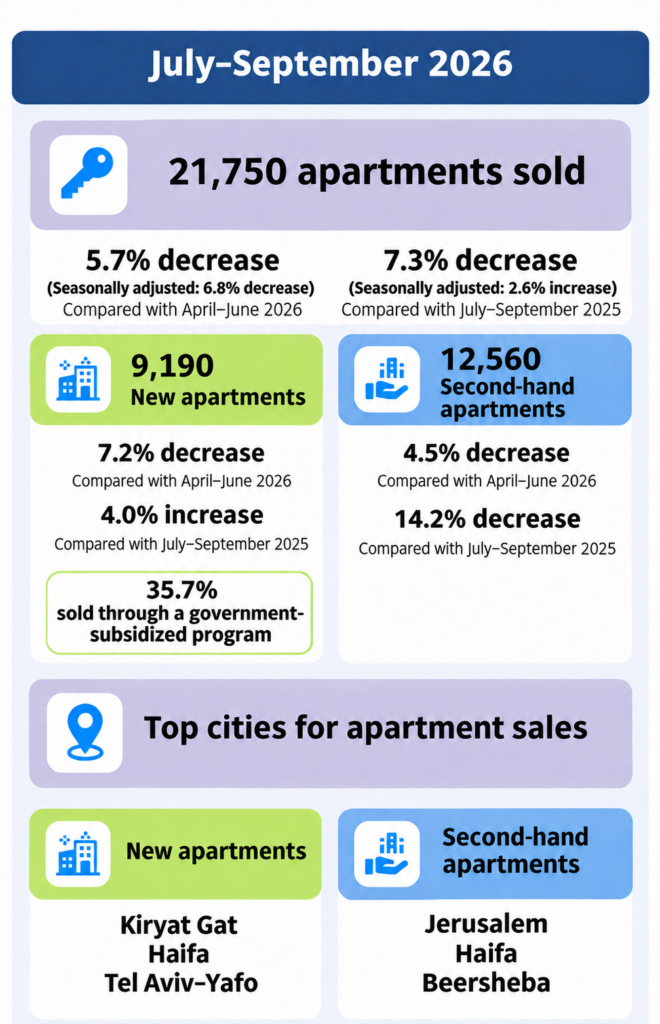
Today the Central Bureau of Statistics (CBS) and the Ministry of Finance’s Chief Economist Division published their latest figures, and both point the same way. According to the CBS, Israel home sales totaled about 21,750 apartments in July through September 2026. That is 5.7% fewer than in the spring and 7.3% fewer than in the same quarter last year. Second-hand homes did worst, at about 12,560 sales, down 14.2% year on year. New apartments totaled about 9,190, and 35.7% were sold under government-subsidized programs such as Mechir LaMishtaken.
September brought the sharpest fall in Israel home sales. The CBS counted about 6,150 deals, down 15% from about 7,230 in September 2025, and resale deals fell to about 3,530, a drop of 21%. The High Holidays explain part of that, but not all of it. The Finance Ministry notes that September had almost as many working days as the previous year. In the ministry’s own long-term comparison, only 2002, 2018 and 2023 recorded fewer free-market deals in September.
There is one more positive figure. The CBS trend line, which smooths out seasonal swings, still shows modest growth of about 1.1% a month since January. The CBS itself cautions that its most recent trend figures can be revised substantially. The raw numbers are unambiguous: fewer people bought homes this summer than last.

Tel Aviv Takes the Hardest Hit
Total sales in the Tel Aviv district fell 29% from the spring, the steepest drop of any district. Year on year, they fell 16%, matched only by the Central district. New-home sales in the Tel Aviv district dropped 43% from the spring, and resale deals were down 24% from last summer. In Tel Aviv-Yafo itself, developers sold just 537 new apartments, compared with 1,328 in April–June, a fall of almost 60%.
Meanwhile, the city has about 10,065 unsold new apartments. At the third quarter’s sales pace, clearing that stock would take nearly five years. That figure is simple arithmetic, not an official estimate, but it shows the scale of the imbalance.
Jerusalem, Beit Shemesh and Modi’in
The capital shows the same imbalance on an even larger scale. Developers in Jerusalem sold 362 new apartments, down from 501 in the spring. The city has about 10,186 unsold new apartments, more than any other city in Israel. At the summer’s pace, those would take around seven years to sell. Resale activity held steady compared with the spring at 829 deals, but resale sales across the Jerusalem district were 17.6% below last summer. There was one positive: new-home sales across the wider Jerusalem district rose about 20% year on year.
Beit Shemesh was a rare bright spot. Developers sold 236 new apartments, almost three times the spring figure. Second-hand sales slipped 13% to 280, and about 3,013 new units remain unsold. Modi’in is the opposite case. Resale deals fell 22.6% to 185, and the city has just 97 unsold new apartments, the lowest figure of any large city on the CBS list. Buyers looking for new construction in Modi’in have very few options today, but more supply is on the way. In October, the Central District Planning Committee approved Ma’ayanot, a new neighborhood of 3,575 homes in the north of the city and the first to be built in the city’s next phase of expansion. The land has not yet been marketed, and the first tenders are expected from 2027.
The Coast, the South and the North
On the coast, results were mixed. Netanya’s new-home sales rose 56% from the spring to 256, but resale deals fell almost 11% to 327, and about 3,261 new apartments are still unsold. Herzliya’s developers sold 171 new units, up 36%, with 1,616 still on the market. Ra’anana’s sales are not broken out in the CBS figures, but the city has about 1,380 unsold new apartments.
In the south, Kiryat Gat led the entire country with 1,030 new apartments sold, although 78.3% of them were subsidized. The city still has about 3,170 unsold new units, the largest stock of any city outside the major population centers. Ashkelon’s new-home sales fell 41% to 240, while resale deals edged up 6% to 423. The north was the strongest region: total sales in the Northern district rose 26% from the spring, led by a 76.5% jump in new-home sales. In the Israeli communities of Judea and Samaria, new-home sales fell 42%, and resale deals 17% compared with the spring.
More Than 85,000 Apartments and Counting
The national inventory is still enormous. At the end of September, the CBS counted about 85,080 unsold new apartments, more than 15,000 above the level of two years ago. The Tel Aviv district holds 31.2% of that stock and the Central district 24.8%. At the current sales pace, it would take 25.8 months to clear. That is down from a peak above 30 months late last year, but still more than two years of supply.
Developers Bring Back the Sweeteners
Developers holding that much stock need buyers, and the Finance Ministry’s data shows how they are attracting them. The ministry tracks five tax regions closely: Central, Tel Aviv, Hadera, Netanya and Beersheba. In those regions, 45% of developer deals in September carried a financing benefit, 15 percentage points more than in August. That is the highest share since March 2025, just before the Bank of Israel restricted such arrangements. In the Hadera region, the share reached 74%. In the Beersheba region, it jumped to 58% from 22% a month earlier, and in Tel Aviv it rose to 34%. The ministry says it cannot yet explain the surge but notes that it is not confined to one area. The terms of these deals vary widely, and buyers should read them carefully.
Investors Head for the Exit, Diaspora Jews Stay
The ministry’s breakdown by buyer type shows local investors pulling back sharply. Investor purchases fell 29% year on year in September, to 849 apartments, the steepest drop of any buyer group. In the Central region, investors bought just 84 apartments, one of the lowest levels there in two decades.
Buyers from abroad did not follow them. Foreign residents bought 154 apartments in September, almost the same as the 157 a year earlier and a third more than in August, a rise the ministry links to the holiday season. After subtracting their sales, net purchases came to 119, up from 103. Jerusalem drew 54% of these buyers. By passport, 54% were American, 17% French and 8% British.
As reported last week, Tax Authority Director Shai Aharonovich acknowledged that a temporary cut in the investor rate would likely boost demand. He added that the market has not yet reached crisis level, but that the state is prepared to take emergency measures if conditions worsen. No cut has been proposed so far.
Calling It What It Is
The official data on Israel home sales leaves little room for spin. Sales are down, more than 85,000 new apartments are unsold, and developers are relying on incentives. Tel Aviv’s new-home market slumped, local investors are leaving, and resale activity had one of its weakest Septembers in decades.
Nobody can say where prices will go, and anyone who claims to know should be treated with caution. As our Chief Editor, Debbie Goldfischer wrote, buying in Israel today is not a bet on quick profits. For many Jewish families abroad, the reasons are personal: a home for the years ahead, a place for children and grandchildren, and a haven at a time when many are questioning their future where they live now. For buyers who see it that way, a slow market with motivated developers is a moment worth paying attention to.
The Buyitinisrael Editorial team is made up of industry experts, journalists, researchers, editors, and translators working together to deliver reliable, up-to-date information about the Israeli property market — all in English. With a strong focus on transparency and accessibility, our goal is to empower English-speaking buyers by helping them understand the market and navigate the real estate process with clarity and confidence.
For inquiries, email [email protected].