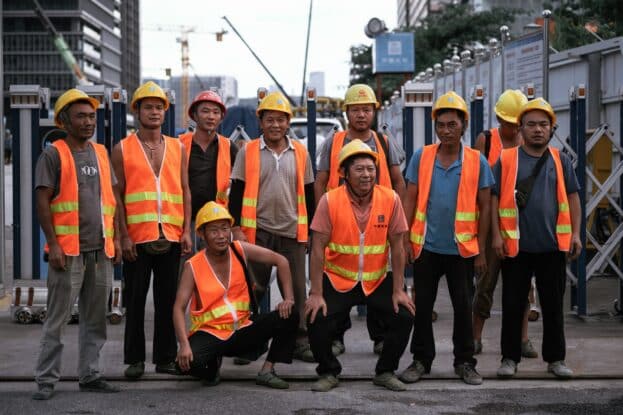
The Jerusalem District Court has rejected petitions filed by three Chinese construction companies challenging a tender requirement issued by the Ministry of Housing. The clause bars companies from countries ranked at the lowest level in the U.S. State Department’s Trafficking in Persons report from participating. The ruling upholds the state’s position that foreign construction workers from these countries should be proactively barred to reduce the risk of human trafficking.
By Dror Neer Kastel, Nadlan Center
Last week, the Jerusalem District Court, sitting as an administrative court, rejected two petitions filed by three Chinese construction companies. The companies had challenged a clause in a Housing Ministry tender that bars participation by firms from countries ranked in the lowest tier of the U.S. State Department’s Trafficking in Persons report—such as China.
The arrangement with foreign construction companies, first approved in 2015, allows such companies to bring in foreign construction workers without the need for bilateral agreements and without oversight of the recruitment process. Unlike regular labor migrants, these workers cannot switch employers and are entirely dependent on the company that brought them to Israel. Due to the problematic nature of the arrangement and the serious harm it can cause to workers, an inter-ministerial government team was formed to examine its future. That team has yet to publish its conclusions.

In 2020, 2021, and again in 2023, China was ranked at Tier 3—the lowest level—in the U.S. State Department’s Trafficking in Persons report. This tier includes countries whose governments do not fully comply with the minimum standards to combat human trafficking and are not making significant efforts to do so.
The petitions were submitted in response to a call for proposals published in July 2024. The tender invited new foreign construction companies to join a pool of at least ten firms aimed at boosting residential construction in Israel. Participating companies would also receive government support for bringing in foreign construction workers, in line with a government decision from February 2024. The petitioners argued that the clause excluding Chinese companies is discriminatory and unreasonable. They claimed it relies on a report with no binding authority in Israel, unfairly punishes companies that have not been accused of any wrongdoing, and is based solely on general information about China. They also contended that it imposes harsher conditions on them than those applied to Chinese firms already operating in Israel under earlier tenders.
The organizations Kav LaOved and the Workers’ Rights Clinic at Tel Aviv University joined the proceedings as amici curiae (“friends of the court”), supporting the state’s position. In their submission, the organizations emphasized the importance of the U.S. State Department report as a tool to prevent harm to foreign construction workers and criticized the current arrangement for its failure to protect workers. They argued that because the system deviates from the standard protections afforded to labor migrants in Israel, it is critical to take preventive measures against potential abuse—especially considering China’s documented deficiencies—rather than waiting for violations that may be hard to investigate or remedy later.
Judge: Foreign Construction Workers Require Protection
Judge Avraham Rubin accepted the position of the state and the supporting organizations. He cited the testimony of the government’s National Coordinator for Combating Human Trafficking, who explained during the hearing that the U.S. State Department’s report “is considered the most accepted report on the issue in both international and academic circles.” The Judge emphasized the importance of being proactive in preventing risks of human trafficking and employment conditions that may amount to slavery—particularly under the foreign execution company arrangement.
The Judge added that the state has full discretion over decisions regarding foreign construction workers: “The starting point in reviewing these petitions is that the petitioners cannot claim any vested right to operate in Israel. The approval of foreign companies to operate in Israel and bring in foreign construction workers is subject to state discretion. Under this tender, foreign companies are offered benefits to encourage their operation in Israel, which is tied to the state’s interest in expanding the residential construction market. … In formulating this tender, the state must balance its interest in boosting housing supply and keeping construction costs reasonable with its duty to protect the rights of foreign construction workers, who are a vulnerable population exposed to economic and employment exploitation, and therefore require protection. The means to achieve this balance involve policy and professional considerations, and in such matters, the court does not intervene lightly.”
The Judge concluded: “I am convinced that the state acted reasonably and proportionally when it decided to exclude companies from Tier 3 countries, based on a report that is considered one of the most reliable sources of information on human trafficking. This measure was taken not as a sanction against specific companies, but as a preventive mechanism in a system already characterized by increased risk to workers.”
Attorney Elad Kahana, Director of the Legal Department at Kav LaOved, stated: “The arrangement with foreign execution companies in construction is one of the most harmful existing labor migration frameworks in Israel. It has led to some of the most extreme cases of worker exploitation we have encountered—including recruitment fees that leave workers in debt and employment conditions that border on forced labor. We are pleased that the court adopted our position: that given China’s extremely low ranking in the U.S. report on trafficking, it is imperative to prevent companies from bringing foreign construction workers from China under this problematic arrangement.”

Nadlan Center is Israel’s leading real estate news and knowledge platform in Hebrew, created for industry professionals. Founded by experts in the field, it delivers in-depth, up-to-date coverage on urban renewal, planning and construction, taxation, and housing policy — tailored to the needs of developers, investors, planners, and financiers. In addition to its widely read news content, Nadlan Center hosts major industry events, professional conferences, and training programs that support the growth and development of the Israeli real estate sector.
Learn more: https://www.nadlancenter.co.il