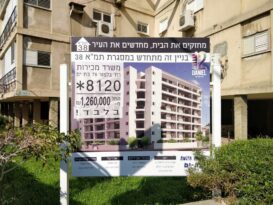
A Magistrate’s Court ruling held that extensive building renovations that significantly disrupted tenants’ use of a rented apartment constituted a material defect, entitling them to a substantial rent reduction and financial compensation. The court found that the landlord’s obligation to provide a suitable property is ongoing throughout the lease, rejected claims that the tenants waived their rights, and ordered the return of overpaid rent and an unlawfully withheld deposit, along with damages for emotional distress.
By Adv. Liel Menaged Shatz with the assistance of Hodaya Alon
This case concerns a couple who entered into a 12-month lease with the landlord for a residential apartment in Tel Aviv. The agreement included an option to extend the lease for an additional year, during which the landlord was entitled to increase the rent by up to 3%. Upon signing, the tenants deposited a security deposit with the landlord to guarantee all of their obligations under the rental agreement.
In this article, we review the Magistrate’s Court ruling, which accepted the tenants’ claims and determined, among other things, that the renovation carried out in the property constituted a significant defect, requiring a reduction in rent. This was based on Sections 6 and 9(a)(2) of the Rental and Lending Law, 1971, and Section 11 of the Sale Law, 1968.
Circumstances of the case:
A lease agreement was signed between the parties. Approximately three months into the lease term, extensive renovation and maintenance work commenced in the building. These works, which lasted several months and significantly affected the tenants’ use of the apartment, caused a substantial impairment to the property’s reasonable use. Accordingly, the tenants approached the landlord requesting a 50% reduction in rent. The parties conducted negotiations but did not reach an agreement because the landlord demanded that the rent reduction be conditioned on vacating the apartment within three months. In addition, the landlord discovered that the tenants had not paid their utility bills for eight months. Despite the renovations, the tenants continued living in the apartment and even exercised the option period, paying rent with a 5% increase (instead of the agreed 3%, due to an error in issuing the checks).

Tenants’ claims:
The tenants argued that they were not informed in advance of the expected renovations, even though the landlord knew about them before signing the agreement. Due to the renovations, they were unable to use the balcony and garden, which were the primary reasons they chose to rent the property and agreed to pay higher rent. In addition, the removal of the balcony railing during the works created a real safety hazard for their children. Regarding the bills, the tenants claimed they could not transfer them into their names because the apartment was registered in the landlord’s name rather than in another party’s, whose details were unknown to them. They further noted that the issue was resolved immediately upon receiving a warning letter from the landlord, and no actual financial damage was caused. Regarding the option period, the tenants argued that the landlord attempted to condition the exercise of the option, to which they were entitled under the agreement, on their waiving claims arising from damage suffered during the renovation period. Moreover, under the agreement, the landlord was permitted to increase rent during the option period by only 3%, yet in practice charged 5% due to the tenants’ mistake in writing the checks. Therefore, they claimed entitlement to a refund of the difference for the entire period. Regarding termination of the lease and forfeiture of the deposit, the tenants argued that they caused no damage to the property; on the contrary, they returned it in improved condition, and thus the landlord’s forfeiture of the deposit was unlawful. In addition, they sought compensation for emotional distress due to the prolonged impact on their quality of life.
Landlord’s claims:
The landlord argued that he was unaware of the renovation works at the time the agreement was signed and that once he became aware, he immediately informed the tenants. He claimed that he even offered the tenants the option to vacate the apartment before the end of the lease term, and therefore, they were not entitled to a rent reduction. He further argued that for an extended period, the tenants failed to pay the bills or transfer them into their name, despite their contractual obligation to do so. He also claimed that the tenants’ waiver of claims in exchange for exercising the option had already been agreed upon orally, enabling the continuation of the lease and its extension. Additionally, the landlord argued that the rent paid during the option period (including the 5% increase) was paid without protest, indicating it was not a mistake. He further claimed that the tenants left significant damage to the apartment that exceeded the deposit amount; altered the apartment without consent (by painting a wall in an unusual color, according to him); delayed vacating the property; and failed to pay the final electricity bill. Therefore, he asserted that forfeiting the deposit was lawful.
Decision:
The court accepted all of the tenants’ claims, except their claim regarding the landlord’s alleged bad faith, as it could not be established as a fact that the landlord knew about the renovations at the time of signing the agreement. The court ruled that the renovations created a significant defect in the property. This defect constituted a breach of the lease agreement, entitling the tenants to a rent reduction under Sections 6 and 9 of the Rental Law and Section 11 of the Sale Law.
In its decision, the court relied, among other things, on CA 4893/14 Zoubi v. State of Israel – Ministry of Finance (Nevo, 03.03.2016), which established that a landlord’s obligation to provide a property that is suitable and consistent with the agreement is an ongoing obligation throughout the entire lease period. Regarding the extent of the rent reduction, the court relied on CA 355/80 Anisimov Ltd. v. Tiberias Bat Sheva Hotel Ltd. (1981), which held that the court may estimate the reduction based on the evidence and circumstances presented.
The court further determined that the tenants had overpaid rent during the option period due to a good-faith error in issuing the checks. It also ruled that no agreement had been formed conditioning the exercise of the option on mutual waiver of past claims. Additionally, it found that the landlord unlawfully forfeited the deposit because he failed to prove damages that justified such action. The court relied on TA (Magistrate) 26774-05-18 Shtrak v. Kol (Nevo, 15.9.2019), which established that the landlord bears the burden of proving, through clear evidence, that the tenants returned the property with damage beyond reasonable wear and tear, justifying forfeiture of the deposit.
In light of the above, the court ruled that the landlord must return to the tenants half of the rent for the renovation period, refund the excess payments collected during the option period, and return the unlawfully forfeited deposit. In addition, the tenants were awarded compensation for emotional distress and legal expenses.
Author’s note:

The ruling strengthens and clarifies the landlord’s ongoing obligation to ensure that the rented property remains consistent with the agreed terms throughout the lease term. It establishes that a breach of this obligation may entitle the tenant to remedies. The ruling also makes clear that a landlord’s forfeiture of a deposit requires proof of damage supported by strong evidence to be upheld in court. The decision serves as a clear warning to landlords and emphasizes the need for fair, transparent, and well-documented conduct throughout the lease period.
(TA 4833-05-23 Teshuva et al. v. Tabu (Nevo, 09.12.2025).
Gindi Caspi & Co. is one of Israel’s most prominent law firms in real estate, planning and zoning, and urban renewal. With decades of extensive experience handling complex and large-scale real estate transactions, the firm is consistently ranked among the top-tier firms in these fields by all major rating companies. Notably, the international LEGAL 500 recognized Gindi Caspi & Co. as a Leader in real estate, planning, and zoning and highlighted Adv. Ziv Caspi as a Leading Individual in Israeli law. The firm has also received numerous accolades, including ranking among the top real estate law firms (Dun’stars) in planning, zoning, and urban renewal. It was honored as a “pillar and cornerstone in fulfilling the nation’s vision for building and settling the land.” For five consecutive years, the firm has been ranked first in Israel in the field of urban renewal.
For inquiries, contact [email protected].