Translated from Michael Eisenberg’s Hebrew post on X — read the original here.
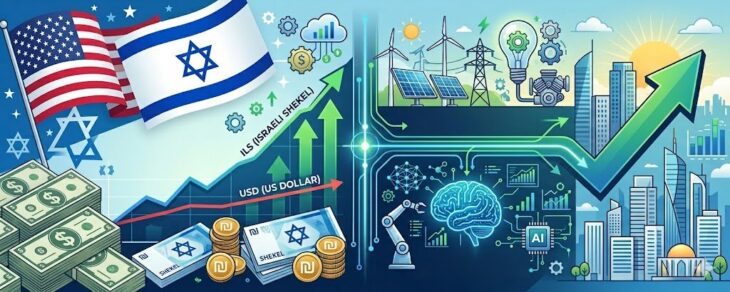
Many are anticipating the Bank of Israel’s interest rate decision. Still, the real drama isn’t a matter of basis points — it’s the macroeconomic trap that has formed between Jerusalem and Washington.
Most of the market expects a rate cut (and perhaps several this year), and I believe the Bank of Israel will indeed cut rates to ease the local mortgage market and prevent further damage to the tech sector from an overly strong shekel. But to understand where the dollar-shekel pair is really headed, you have to look at what’s happening on the other side of the ocean — and there, an event of Nixonian proportions is unfolding.

The American “Feature”: Inflation as a Tool
It’s important to note upfront that over the past two decades, the dollar has steadily eroded against the shekel, and I’ve written before that my long-term forecast is that this trend will continue.
But today a drama is playing out that goes beyond the long-term trend of growth differentials and risk premiums. Macroeconomically, the United States is in a political and structural dead end. National debt has crossed the 100% of GDP threshold. Cutting the welfare state is extremely difficult (especially during election cycles), and defense spending and global wars are only rising. The need to upgrade infrastructure — largely untouched since the 1960s — and the necessity of reshoring to reduce dependence on China demand massive investment. The only way out of the hole America has dug itself into is not austerity, but an all-in bet on growth that contains within it a monetary and energy paradigm shift. The US is in the middle of a dramatic move reminiscent of Nixon’s decoupling of the dollar from the gold standard in the 1970s, which eroded the value of dollars held by people around the world. They can do this because they are still the world’s reserve currency.
The apparent American strategy is a multi-trillion-dollar gamble aimed at accelerating GDP growth and thereby reducing the debt-to-GDP ratio — not by shrinking the debt or cutting spending, but through explosive growth powered by two superengines: artificial intelligence and energy abundance. (I’ve written before that I expect the US to grow rapidly and sustain above-5% growth for several years, which will ultimately reduce the debt.)
But this bold economic growth push requires enormous capital for computing infrastructure, data centers, nuclear energy, oil drilling, and the quantum revolution — as well as investment in geopolitical-kinetic issues such as Venezuela, Iran, and the Middle East, some of which expand energy reserves and lower prices while others create leverage over China. As noted, lower energy prices and energy abundance are critical to accelerating growth.
To encourage these investments, cheap and available credit is essential. The entry of Kevin Warsh to the Federal Reserve signals a change in direction — likely a push to cut rates and release more credit into the market, even despite the expected inflation that is already appearing in the data. Warsh, an exceptional economist, knows from his work with legendary investor Stanley Druckenmiller and others the world of AI and the economic potential embedded in it. He understands that accelerating AI will actually lower the cost of living in the long run. Technology — and AI in particular — is deflationary over time. Energy abundance will also push prices down over time.
Inflation ahead? That’s a feature, not a bug. The inflation already rising in the US is part of the plan. It will gradually erode America’s real debt burden — at the expense of other countries around the world that hold billions in US Treasury bonds and will absorb the cost. Exactly as in Nixon’s day. As then, those holding dollars can expect to find themselves holding an asset of diminishing value. (Disclosure: in February 2022, I urged the Bank of Israel to diversify its holdings and even begin holding Bitcoin.) In the meantime, the US will invest cheap money in AI infrastructure and reap all the gains from growth and falling prices afterward.
The Bank of Israel’s Trap
On one hand, a dramatic rate cut by the Bank of Israel would fuel domestic inflation in an economy already suffering from supply-side problems, and already at inflationary risk due to the war, a budget loaded with spending and too little structural investment.
On the other hand, maintaining an overly strong shekel directly strangles our main growth engine — the tech industry and exports. The current interest rate, combined with other trends (see Avishai Ovadia’s new book), is also beginning to crack apartment prices — a leveraged asset — which has spawned dangerous and foolish ideas like mortgage subsidies.
The point is that the situation is not entirely in the Bank of Israel’s hands. Israel cannot beat an international dollar trend through rate cuts alone. You can soften the blow, but given the size differential between the US and Israeli economies, it would be like trying to fence off a tsunami.
Broadly speaking, Israel today is reaping the fruits of seeds planted over several decades. Massive investment in the military and security establishment has trained generations of people to tackle challenges, solve problems, work under pressure, and build breakthrough technologies. As I’ve written before, Israeli entrepreneurs are built precisely for the current era — an age of uncertainty saturated with instability. The tech sector Israel has cultivated is recognized worldwide, and the result is a significant current account surplus, a steady flow of dollars into Israel, and a strong shekel.
You can’t navigate this situation through rate cuts alone. We are, in fact, heavily exposed to the great American move, which is affecting us enormously. Solutions must be found — not a day goes by (including today) without entrepreneurs writing to me about the insane costs of employing people in Israel due to shekel appreciation.
The Agents Revolution and the Threat to Israeli Tax Revenues
But there are no magic solutions. Let me say upfront: I don’t share the doom-and-gloom view that the entire labor market is about to collapse. I don’t share the prediction that there will be no “programmers” in two years. Yes, things will change — perhaps dramatically. But the market won’t collapse. New data shows that demand for programmers is rising, likely because the volume of code is growing (see GitHub statistics), and humans are still needed to manage all that code and all those projects. Skills will shift, but demand will persist.
That said, the AI revolution will reshape the global economy, and certainly the Israeli economy. A side note: credit to Finance Minister Smotrich, reserve Brigadier General Erez Askel (head of the AI division), and the Prime Minister for passing a budget of nearly 3 billion shekels for artificial intelligence. These changes have implications for the tax system, the budget, and also the shekel-dollar rate — because a strong shekel makes it possible to import some of the computing and communications infrastructure that will accelerate growth and may (combined with other tools) lower the cost of living, enabling lower interest rates and reducing the war debt we’ve accumulated.
The strong shekel significantly impacts Israeli tech companies’ expenses and shortens their runway. As mentioned, it makes hiring in Israel very difficult. And so, instead of the risk of outsourcing jobs abroad, there is an incentive to shift from expensive developers to AI Agents — artificial intelligence agents that are replacing a growing portion of developer work. These agents are priced in dollars (not shekels like Israeli salaries) and are far cheaper. The implication? Tech companies may be more profitable, but they’ll need less expensive Israeli manpower.
As a result, many talented people will no longer be employees but will instead found their own agent-based companies. This will affect the tax base. Israel has built its budget on the high-income taxes of tech programmers and on real estate taxes, where, as noted, a mini-crisis is beginning to emerge. Once value shifts from wages to intellectual property (IP) and dollar revenues of lean teams, that old model is dead.
The expected process demands an urgent shift in thinking: the state must stop penalizing holding companies with taxation and instead encourage their establishment in Israel. As described, programmers will set up companies run by one or two people and dozens of agents operating 24/7. They’ll form independent companies, and some will manage agents on an outsourced basis for larger companies. Israel needs to become the best place in the world for individual entrepreneurs to establish super-profitable, efficient agent companies and agencies that channel money into the economy. For reference, the American QSBS is a tremendous incentive to incorporate in the US, and Israel must do everything in its power to ensure that companies are incorporated as limited liability companies here.
What else? The state budget will need to invest far more in infrastructure — not just computing infrastructure, but all infrastructure that accelerates economic growth. Our budget goes too much toward spending (welfare, etc.) and too little toward investing in the next wave of growth. We must accelerate. Like the US, we can live in a lower-interest-rate environment if we know how to accelerate growth — especially through AI-based projects that will bring down prices domestically. Accelerating growth is possible through market liberalization and regulatory cuts. My recommendation is always to optimize metrics, and today that means optimizing the speed of execution of physical and human infrastructure and cutting regulation.
And so, the question is not just by how much the Bank of Israel will cut rates.
The big question of the coming years is whether the US will succeed in generating a wild AI and cheap-energy productivity surge without destroying global confidence in the dollar and its bonds (the American stablecoin strategy and oil priced in dollars).
As a corollary, Israel must free itself from managing the exchange rate and the economy solely through interest rates. We need to open markets by removing tariffs and import restrictions, reduce regulatory overload, shift to a growth-oriented budget, and build a tax regime suited to small, lean, IP-based companies and AI agents — rather than remaining stuck with yesterday’s tax system and an overly strong shekel that protects an old economy.
The sharp move in the shekel-dollar rate we are experiencing is a signal of a shift in pace. Policymakers would do well to start moving faster, because the global technological, economic, and geopolitical environment — and the US itself — are changing rapidly. Only that way, over time, will we be able to cope with a stronger shekel while our economy continues to grow.
Closing note: I am aware that part of the shekel-strengthening trend stems from the massive funds institutional investors are accumulating and investing in American markets, and their hedging activity.

Michael Eisenberg is Co-Founder and General Partner at Aleph, an early-stage venture capital fund with over $500 million under management. He has been a venture capitalist for 25 years. Aleph focuses on partnering with great Israeli entrepreneurs to build large, meaningful companies and impactful global brands. Since its founding in 2013, Aleph has invested in more than 40 companies, including Melio, Lemonade (NYSE: LMND), Bringg, JoyTunes, and Healthy.io.
Since 2006, Michael has been writing the blog “Six Kids and a Full-Time Job” on topics ranging from politics to technology, Judaism, and macroeconomics. He lectures frequently on venture capital, Israel, and entrepreneurship. In 2020, Michael established the Nevo Network, a first-of-its-kind fellowship program to elevate olim (immigrants to Israel) working in high-tech. Michael lives in Jerusalem with his wife and eight children.