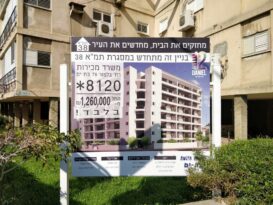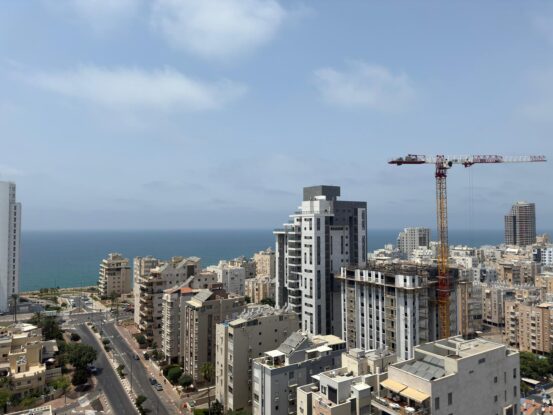
After years of steady gains, Israeli home prices are slipping, developers are sitting on record unsold stock, and no honest professional can promise capital growth at the moment. Add global instability, deep uncertainty, and a strong shekel that has made Israel pricier for overseas buyers, and he old promise of easy capital gains simply no longer holds. As a pure financial investment, Israel may not be your best bet today, and buyers deserve to hear that plainly. But a home here was always about much more than financial returns. From protecting your assets to securing a real Plan B, the reasons to buy still hold, whatever the market does next.
For most of my twenty-plus years as a real estate professional, I could tell clients something with confidence: buy in Israel, and whatever happens, the property will be worth more down the road. Prices rose for so long that it felt like a law of nature. I can no longer promise that. According to the Central Bureau of Statistics, average home prices fell 0.6% in July and August 2026, are down 1.8% over the year, and have declined in seven of the past twelve months. Developers are sitting on a record pile of unsold apartments, and many are committed to projects they took on when the market looked very different, which are far less profitable today than they expected.
It bothers me how many marketing campaigns, seminars and well-meaning advisers keep repeating that Israeli prices only go up, that the market is unbreakable, and that Israel property investment is guaranteed to pay off over the long term. Anyone who tells you that with certainty is selling you something. We are living through a period of serious instability, with conflict in our own region and beyond, rising tension between major powers, political turbulance, the upheaval AI may bring to entire industries, and the risk of a recession.
So here is my honest position. I don’t know where this market is going. Prices may recover and climb again, but they may also fall. What I do know is that buying a home in Israel was never purely a financial decision for most of the people I work with, and when you strip away the investment pitch, the case for owning here remains surprisingly strong. These are the reasons I still believe every Jew who can, should own a home here.
1. Move Assets to Israel
Many overseas buyers I speak with put it bluntly: they want to get some of their money out. Antisemitism has moved from the margins into campuses, workplaces and city streets, and keeping every asset in a country that may not always welcome you no longer feels safe. A quieter worry remains. Today, sending money from abroad to buy a home in Israel is relatively straightforward, but with boycott and sanction campaigns gaining ground in parliaments and unions, nobody can promise it will stay that way. Future restrictions, extra scrutiny, or punitive taxes on transfers to the Jewish state are not unthinkable. A property already registered in your name in Israel has made the journey, and no policy abroad can change that.

2. Have a Real Plan B
The ground has shifted. New York, home to the largest Jewish community outside Israel, elected Zohran Mamdani, one of Israel’s sharpest critics, as mayor, and last week’s US midterms sent several more outspoken critics of Israel to Congress. Britain, France, Canada and Australia, long counted among Israel’s friends, have recognized a Palestinian state, and in Britain, candidates running largely on opposition to Israel have won seats in Parliament. Around the world, Jews are feeling more isolated and less comfortable, and nobody knows where this leads. With a home here, if life where you are becomes difficult or frightening, you are not searching for a rental from abroad, competing with thousands of others who had the same thought on the same day, or living out of suitcases while you figure things out. You have somewhere to go, a place that is already yours.
3. Buy Calmly, Not in Crisis
People who wait until they truly need to move tend to buy under the worst possible conditions: in a hurry, from a distance, with limited choice and little room to negotiate. Under pressure, it is easy to compromise on location, overpay, or skip the checks that protect you. Decisions made in a panic are rarely the ones people are happiest with years later. Buying while you can still think clearly, visit properties, compare neighborhoods and take proper advice is a form of protection in itself. Whatever prices do afterward, you made the decision on your own terms.
4. Don’t Count on Selling Later
Many overseas buyers assume that when the time comes, they will sell their home and use the proceeds to buy in Israel. That plan depends on what your home will sell for, and what that money will be worth once it reaches Israel. Take, for example, northwest London, the heart of the city’s Jewish community, where prices have fallen, homes are sitting on the market, and the few buyers around have plenty of choice. Then there is the exchange rate: with the shekel strong, pounds and dollars buy less here than they did a few years ago. Get caught on either front and the plan can slip out of reach. Buying something, even something smaller than your dream home, means you are not betting everything on markets you can’t control.
5. Rent Is a Return Too
Capital gains are only one way an Israeli property investment pays you back. While overall prices have been falling, rents have been moving the other way. In April and May 2026, CBS data showed home prices down 2% on the year while rents for new tenants rose 6.6%, as we reported in our coverage of the latest price index. Whether you rent your apartment out, or you and your children use it instead of paying a landlord or a holiday rental, the property produces real value, even in a year when its paper price goes nowhere.
6. Diversify Into Shekels
Most families abroad hold nearly everything they own in a single currency, tied to a single economy and a single political system. Pensions, savings, the family house and the business are all in dollars, pounds, euros or rand. A home in Israel is one of the few significant assets many of them will ever own that sits entirely outside that system. That is diversification in the plainest sense, and a more honest way to think about Israel property investment. It doesn’t promise a return, and the shekel can move against you as easily as for you, but spreading what you own across countries and currencies means a single shock in one place cannot touch everything at once.
7. Seize the Buyer’s Market
This is not a forecast, but rather a description of where things currently stand. At the end of August, around 85,680 new apartments were still unsold, enough to take roughly 26.7 months to clear at the current pace of sales, according to our analysis of the summer figures. Developers are competing hard for every buyer with payment plans, upgrades and financing incentives, and in many projects there is genuine room to negotiate. Borrowing conditions are easing as well, with the Bank of Israel cutting rates this year, including a reduction to 3.5% in July. Buyers have more choice and more leverage today than they have had in years.
8. Demand That Doesn’t Go Away
Israel’s population is one of the fastest-growing in the developed world, driven by high birth rates and continued immigration, and the country has struggled with a housing shortage for decades. None of that guarantees prices will rise next year, or the year after. It does explain why demand for homes here keeps coming back, and why a long, deep collapse is harder to imagine than in markets with stagnant populations and overbuilt cities. The people who need places to live are not going anywhere.
9. Own a Piece of Our Beloved Country
Finally, there is the reason that never appears in a price index. For generations, Jews have prayed to return to Zion. Owning a home in Israel means holding a real, personal stake in our homeland, a share in building our country and a concrete step toward that return. And if you don’t make the move yourself, it is a legacy you can hand to your children or grandchildren, in the hope that one day they will build their lives here. That value doesn’t fall in a bad quarter, and it doesn’t depend on whether a forecaster gets it right.
Buy for the Right Reasons
If you are looking at Israel property investment simply for financial return, there are other places to put your money, in assets you may understand better and can watch more closely. But if you are asking whether owning a home in Israel still makes sense, my answer hasn’t changed. A home is not a stock: if you buy sensibly and are never forced to sell at a bad moment, a dip in the price index changes very little about your life. Nobody can promise you the market will go up. What I can tell you is that property here offers security, connection, and meaning, and those were always the real reasons to buy. Please G-d, the capital gains will come too. Just don’t make them the reason.

Debbie Goldfischer is the founder and CEO of Buyitinisrael and the host of the Israel Real Estate Podcast: On The House. A prominent figure in real estate since 2004, Debbie has spent two decades helping foreign buyers successfully purchase homes in Israel. Seeing a lack of reliable, English-language resources for navigating the Israeli property market, she launched Buyitinisrael.com in 2020. In addition to leading the platform, Debbie is available to personally assist you in finding the right property—whether new or resale—anywhere in Israel.
To connect with Debbie, email [email protected].