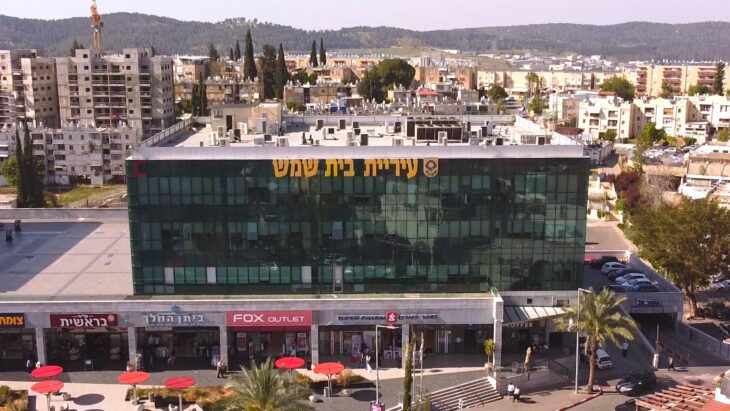
The Jerusalem District Planning and Construction Committee approved on Monday the advancement of the policy document “BS/3000,” which sets out the planning framework for Bet Shemesh for the coming decades. The plan increases the city’s housing supply to approximately 111,000 units, adds approximately 2.3 million square meters for employment, commerce, and offices, and approximately 1.8 million square meters for industry, along with 750 hotel rooms and the development of mass transit systems.
By Dror Nir Kastel, Nadlan Center
The Jerusalem District Planning and Construction Committee approved on Monday the advancement of the policy documents of the Bet Shemesh Local Committee, according to which the city has long-term growth potential, with a population target of over 500,000 residents. This represents the advancement of the policy document “BS/3000,” which constitutes the planning guidelines for the city for the coming decades. The plan is designed to create a planning framework that will enable the city to grow from its current population of 185,000 residents (as of 2025) to a target of 500,000 residents in the decades ahead.
According to the policy document, the planned addition of housing units in Bet Shemesh is approximately 66,000 units. The plan defines the total planned housing units in the city at approximately 111,000 units.
To ensure the realization of the demographic target, the plan places special emphasis on the creation of new employment, commercial, and industrial centers that will increase municipal revenues and provide local livelihood opportunities. Among other things, significant building rights additions are planned in existing industrial zones such as “HaRituv,” along with the addition of employment and commercial areas totaling hundreds of thousands of square meters across various complexes.
In total, a combined addition of approximately 2.3 million square meters of employment, office, and commercial building area is planned, bringing the total employment and commercial area in the city to approximately 2,900,000 square meters. In the industry, an addition of approximately 1.8 million square meters of building area is planned. The total planned industrial area in the city (including currently approved stock) will reach approximately 4.5 million square meters. One of the plan’s goals is to develop Bet Shemesh as a new hotel and tourism hub, including the addition of 750 guest rooms.
The city’s planning framework is based on strengthening existing centers and densifying main corridors. The plan defines detailed guidelines for urban renewal, particularly in the veteran city. Along major routes — including Jordan River Boulevard, Nahal Kishon, and Isaiah the Prophet Street — construction of up to 9 floors will be permitted through demolition-and-rebuild or densification processes, with the requirement of an active commercial frontage facing the street. According to the policy document, the tallest construction is planned in the Southern CBD, where certain plots are to be designated as “exceptional building height zones” that permit construction of up to 23 floors.
“Historic Recognition of Bet Shemesh’s Status”
As part of preparations for a metropolitan city, the policy document outlines an extensive public transportation network connecting the various parts of the city. The plan includes the development of mass transit systems (MTS), including heavy rail, light rail (LRT), and BRT — a rapid bus system — as well as the establishment of bus terminals and a freight terminal. In addition, emphasis will be placed on creating a continuous network of bicycle paths and pedestrian routes to encourage non-motorized movement throughout the city.
The documents define a continuous open-space system linking parts of the city to the surrounding natural assets, including nature reserves, national parks, and ecological corridors. Special emphasis is given to the preservation of Nahal Sorek and its surroundings, and to the development of new tourism centers connected to archaeological and heritage sites such as Tel Bet Shemesh.
The District Committee noted that it “welcomes the advancement of a comprehensive policy document for Bet Shemesh, and sees great importance in establishing a long-term planning framework for the city’s development and setting a population target of over half a million people. The Committee believes that from a district perspective, Bet Shemesh is a significant urban anchor in the Jerusalem District, located in a geographically suitable position for continued development, densification, and strengthening, and that it is appropriate to continue consolidating its growth within the city’s boundaries and its urban development areas, in accordance with national and district planning policy — through efficient land use, strengthening urban continuity, and meeting demands for housing, employment, public services, and infrastructure.”
The Committee further noted that the plan documents have been published in the system for committee members and local authority representatives, and that the committee will reconvene to discuss the plan within 14 days of the decision.
Mayor Shmuel Greenberg: “This is a historic recognition of Bet Shemesh’s status. Setting the strategic target of over half a million residents will allow us to plan ahead for future neighborhoods that will incorporate educational institutions, public facilities, modern infrastructure, and adapted public transportation. Bet Shemesh is becoming a city where everyone can see their future.”
Deputy Mayor and Chairman of the Local Planning and Construction Committee Shimon Goldberg: “The District Committee determined clearly and unequivocally today: Bet Shemesh is the future city of the Jerusalem District. Setting a target of over half a million residents is an enormous vote of confidence in the city and its residents. This is a first-rate strategic decision for Bet Shemesh in recent years. It means securing a development surge, expanding housing and employment supply, and upgrading infrastructure — alongside responsible planning that will ensure a high quality of life for future generations.”

Nadlan Center is Israel’s leading real estate news and knowledge platform in Hebrew, created for industry professionals. Founded by experts in the field, it delivers in-depth, up-to-date coverage on urban renewal, planning and construction, taxation, and housing policy — tailored to the needs of developers, investors, planners, and financiers. In addition to its widely read news content, Nadlan Center hosts major industry events, professional conferences, and training programs that support the growth and development of the Israeli real estate sector.
Learn more: https://www.nadlancenter.co.il