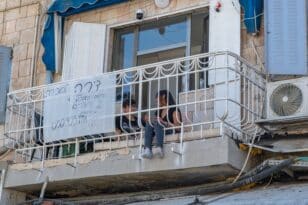
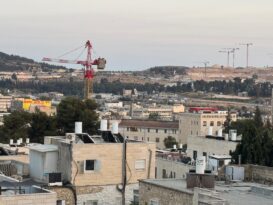
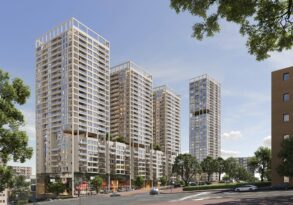
The wave of urban renewal projects currently underway across Jerusalem, with dozens of large-scale developments unfolding simultaneously throughout the city, has created a severe shortage of rental apartments, as residents vacate aging homes and move into temporary rental housing. The result has been a sharp rise in rental prices, significantly exceeding initial projections and turning the availability of alternative housing into one of the central challenges facing urban renewal efforts in the capital.
A wave of Pinui-Binui (evacuation–reconstruction) projects underway across Jerusalem, being carried out simultaneously in dozens of large-scale projects throughout the city, in all of which residents are vacating their aging apartments and moving into rental housing, has led to a shortage of rental apartments in the city and, as a result, to rising rental prices. This was revealed by Hagit Wolf, CEO of Ken HaTor Urban Renewal, during the “Jerusalem’s Future Plans” conference held by Nadlan Center on Wednesday at the International Convention Center in Jerusalem, during a panel discussing the extensive scope of urban renewal currently taking place in the city.
According to Wolf, “Finding rental apartments is very complex, and we are able to pay even 30% more than what we included in the calculations under Standard 21. This is a dramatic issue that requires a systemic solution. Today, this is the main barrier to renewal in my view.”
Attorney and notary Dan Halpert, founder and owner of Halpert & Co., also addressed the rental shortage and said, “We are identifying a problem that will arise further down the line as a result of extensive urban renewal when it comes to alternative apartments. Where will all the evacuated residents go? There is currently no solution. Especially in a city like Jerusalem, where there is a great deal of urban renewal, a solution must be provided because there will not be sufficient alternative housing.”

Halpert also referred to the “building pension fund” solution implemented in Jerusalem in order to ensure building maintenance, saying that it is “a welcome development—systems that will need to be maintained. The question is who manages the money? The money should be managed by someone who knows how to manage trust funds and handle the finances on behalf of the apartment owners.” He also referred to the issue of refusing tenants in the ultra-Orthodox sector, saying: “There is a population that does not recognize the civil courts in Jerusalem, and this needs to be taken into account. With those refusing tenants, we will need to go to rabbinical courts, and this issue is not really being addressed.”
Netta Nissim, head of the Jerusalem Urban Renewal Authority, laid out the current situation in the field of renewal in the city and said: “Today, 400 housing units have been occupied, 4,000 housing units are under construction, and another 7,000 units have already received permits. In addition, we currently have 19,000 housing units in approved plans awaiting entry into the process. I am happy to see growth in permits and believe that next year the number will rise even further. We are creating pressure on developers to move forward. During this period, it might have been expected that developers would delay building permits, but we are not allowing that.”
She added, “For five years now, we have been working very hard with the ultra-Orthodox sector. We made adjustments, conducted outreach, and achieved real transformation on this issue. There are not many advanced zoning plans, but the number of initiatives is phenomenal. In the Ramot neighborhood alone, there are 6,000 housing units in early-stage processes. We have trained social consultants for the ultra-Orthodox sector, which is a new profession within this population, and they are doing excellent work bridging the gaps.”
Shira Telmi Babai, Chair of the Jerusalem District Planning Committee, referred to the massive scope of construction in the city and said, “Sometimes I am accused of working too quickly, but I believe that the development of this city is delayed by 20 years. Jerusalem has run out of land for development, and it was difficult to generate renewal. The policy along the light rail lines has, to some extent, addressed this challenge and created additional construction opportunities along the rail corridors. Mass transit, employment, and housing are being built together, and together they address all the needs of the population.
“This is complex, professional, and sensitive work, and therefore, coordination among all the parties is essential. Today, we can already see the Green Line operating in test runs, and we believe that these elements will synchronize. The city will get through this difficult period of construction and work, and it will be in a very good place.”
Eliezer Rauchberger, Deputy Mayor of Jerusalem and Chair of the Local Planning and Building Committee, said: “In 2024, we had 3,057 housing units that received demolition permits and entered construction. In 2025, we reached 4,092 housing units, an impressive increase. I think developers can do somewhat more within evacuation–reconstruction complexes. Reaching 7,700 permits in 2024 and 8,500 by 2025 is nice, but the burden of proof lies with the developers. Urban renewal also involves a kind of lifesaving necessity, as there are buildings without protection, especially in light of the events of the past two years, and the threat of earthquakes is always hovering.”
Yechiel Segal, CEO and owner of the Beit Yerushalmi Group (BY), said: “Out of the 4,100 urban renewal permits issued by the Jerusalem Municipality this year, the Beit Yerushalmi Group accounts for 27%, with more than 1,000 apartments. Relative to all the permits issued this year, we account for about 15%. We have nearly 9,000 housing units at various stages of development. We have put all our chips on Jerusalem, and we are not afraid, because those who are afraid do not act. Our risk is calculated because we have a vision, and it is important to understand that this is a much bigger event.”
When asked whether there is an oversupply, Segal replied: “Demand continues. We are raising prices and even selling more. Urban renewal across the country is about renewing buildings; in Jerusalem, we are renewing an entire city. Jerusalem will be the smartest city in Israel and the only one that will be able to sell that idea.”
Yaakov Siso, founder and partner at the Yesodot Fund, also referred to the issue of supply and said: “I am always concerned when allocating credit and make sure to analyze inventory and trends, but I must say that in Jerusalem we feel comfortable. We see advanced projects and are satisfied with the process. We see what is happening in Tel Aviv, where projects that have received building permits are being stalled. Developers who worked for several years to obtain permits do not want to realize them, and all of these things lead to projects not starting. This does not happen in Jerusalem, because there are no problems with sales. There is demand from Jews all over the world—Jews from Europe and the United States—who are looking toward Jerusalem.”
However, Siso noted: “I do identify a problem with ‘intermediate apartments,’ where demand is lower. Luxury apartments have waiting lists, while four-room apartments are selling less.”

Nadlan Center is Israel’s leading real estate news and knowledge platform in Hebrew, created for industry professionals. Founded by experts in the field, it delivers in-depth, up-to-date coverage on urban renewal, planning and construction, taxation, and housing policy — tailored to the needs of developers, investors, planners, and financiers. In addition to its widely read news content, Nadlan Center hosts major industry events, professional conferences, and training programs that support the growth and development of the Israeli real estate sector.
Learn more: https://www.nadlancenter.co.il