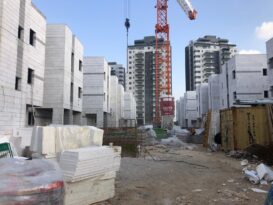
Following Nvidia’s announcement this morning (Thursday), real estate professionals believe the arrival of the global chip giant in Kiryat Tivon will generate new housing demand across a wide range of nearby communities—within up to a 40-minute commute. These include the Jezreel Valley, the Lower Galilee, and the Haifa Bay area—provided these localities prepare adequately with transportation infrastructure and sufficient new construction supply.
By Dror Nir Castel, Nadlan Center
The official announcement by Nvidia this morning (Thursday) that it has chosen Kiryat Tivon as the site for its new campus—expected to employ more than 10,000 workers—ends months of speculation about the location of the company’s new headquarters. At the same time, it raises an equally important question: how significant will the impact be on regional housing demand and pricing?
Conversations held today with several industry figures suggest that most real estate professionals expect the arrival of the chip giant to generate new residential demand across numerous communities within a 40-minute commuting radius. This includes areas in the Jezreel Valley, the Lower Galilee, and the Haifa Bay, with the effect filtering into cities that offer strong transportation accessibility alongside new residential construction.

“The expected entry of Nvidia into the Kiryat Tivon area has the potential to reshape the regional housing market fundamentally,” says real estate appraiser Erez Cohen. “Beyond the immediate employment impact, this move strengthens a major employment anchor in the north and places entire communities back on the demand map—a process we have already seen in Israel around major technology employment hubs.”
According to Cohen, if one is looking for an indication of what may happen in the north, there are clear precedents—chief among them Intel’s activity in Kiryat Gat. “Within just a few years, apartment prices in the city and surrounding communities rose by tens of percent—far exceeding the national average. For example, in the Carmei Gat neighborhood, apartment prices climbed over the past four to five years from around NIS 1.25 million to approximately NIS 2 million. Rental prices also increased by an average of about 30% during that period.”
Cohen adds that another relevant example is Yokneam, where the establishment of large technology employers gradually shifted demand from a local market to a regional one, resulting in a consistent rise in both housing prices and rents. “What all these cases have in common is that it wasn’t the employer alone that drove the increase, but rather the combination of a strong employment anchor, transportation accessibility, and planning supply that failed to keep pace with demand,” he explains.
“In Nvidia’s case, we are dealing with a global company with exceptionally strong pull, so the impact is expected to be broad and gradual—first in the rental market and later in purchase prices, especially in communities that respond quickly on the planning and execution side. The difference between areas like Kiryat Gat and Yokneam versus Kiryat Tivon lies in the character of development. Tivon is primarily composed of low-density single-family housing, which will not be able to absorb the projected demand. As a result, demand is likely to spill over into nearby populated areas such as Migdal HaEmek, Nesher, Haifa, and the Krayot.”
Even before the official announcement, signs of growing interest were already evident. Migdal HaEmek and Haifa are also expected to benefit from Nvidia’s arrival. “This is not just another employment center, but the creation of a technological ecosystem that generates ripple effects and demand within a radius of up to 40 minutes’ drive,” explains Omer Yehimovitz, CEO of Yesodot Eitanim. “The establishment of Nvidia’s campus is a strategic development that will change the face of the entire north. In recent months, following reports that the company might locate in the Tivon area, we already saw a market response in Migdal HaEmek, where we are currently developing a large residential project. Even before this week’s official announcement, we identified a roughly 25% increase in inquiries to our sales office.”
He adds that within a 15-minute drive of the planned campus, high-tech employees will find significant price gaps, with new apartments available at substantially lower prices than in neighboring communities—around NIS 2 million for a five-room apartment and approximately NIS 3 million for a private cottage with a garden. “For young families, the combination of geographic proximity and economic feasibility is a real game-changer, and this is precisely the dynamic beginning to develop around the new campus in the valley.”
Alex Mariash, CEO of Hachsharat Hayishuv Urban Renewal, believes Haifa and its surroundings will also gain considerably. “The establishment of Nvidia’s headquarters near Tivon is one of the most significant developments the Haifa and Krayot region has seen in the past decade, particularly from a regional development and real estate perspective. This move is expected to generate a broad wave of housing demand that will not remain confined to the immediate campus area, but will influence the entire urban space within a commuting distance of up to 40 minutes—from Haifa through the Krayot and surrounding communities.”
According to Mariash, the Haifa and Krayot area offers a unique combination of transportation accessibility, existing infrastructure, academic institutions, and quality of life, making it a natural alternative for high-tech employees and young families seeking to remain in the north while enjoying advanced employment opportunities. He notes that alongside the economic opportunity, there is also a clear need for preparation: efficient public transportation, expanded education and community systems, and investment in advanced urban infrastructure. “If the state and local authorities act in coordination and on time, the Haifa and Krayot region can leverage this move for balanced growth, strengthen the local economy, and establish itself as a leading residential and employment hub in the north.”
Aviad Gerstel, VP of Engineering and partner at Masad Oz Engineering, addresses the broader employment implications. “Nvidia’s arrival is expected to increase not only residential demand, but also the need for offices and employment land throughout the region. The technology giant will attract satellite companies that provide services both directly to Nvidia and to its employees and their families. When an employee relocates to the area, their spouse is likely to seek employment locally as well. As a result, demand for offices and employment infrastructure around the campus is expected to grow, alongside demand for facilities serving chip-industry-related sectors, including factories and supporting suppliers that will bolster Nvidia’s extensive operations and supply chain.”

Nadlan Center is Israel’s leading real estate news and knowledge platform in Hebrew, created for industry professionals. Founded by experts in the field, it delivers in-depth, up-to-date coverage on urban renewal, planning and construction, taxation, and housing policy — tailored to the needs of developers, investors, planners, and financiers. In addition to its widely read news content, Nadlan Center hosts major industry events, professional conferences, and training programs that support the growth and development of the Israeli real estate sector.
Learn more: https://www.nadlancenter.co.il