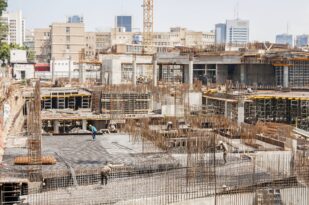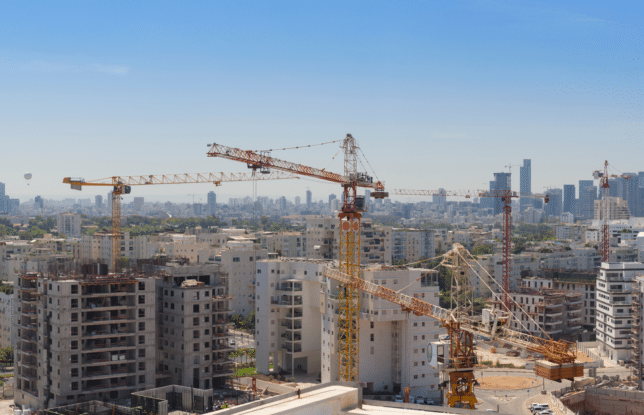
An annual total of 81,000 housing starts promises, on the one hand, continued declines in home prices for an extended period. On the other hand, it raises serious concerns about the future of many construction companies, which are currently building thousands of apartments that no one seems interested in buying. A deep dive into the data reveals that in Q3 2025 alone, around 5,000 apartments were built beyond actual demand, roughly 2,000 of them in the Tel Aviv district.
By Nimrod Buso, Nadlan Center
In the hours following the publication last Thursday of the data from the Israel Central Bureau of Statistics (CBS), showing an all-time record in housing starts over the 12-month period between October 2024 and September 2025—81,020 apartments in total, representing a 31.5% increase compared to the previous 12 months—I spoke with several veteran real estate professionals. These are people who have seen more than a few cycles, trying to understand how they explain this astonishing peak occurring in the midst of one of the weakest periods the residential real estate market has experienced in decades.
Not only were they surprised by the figure (very much so), and not only did they have no clear explanation for the anomaly (they truly did not!), but the dominant impression I took away from these conversations was one of shock. The implications of such massive construction volumes—at a time when housing supply is already at record levels while demand is at a low point—were clear even to them. If the CBS data is indeed accurate, it means that tens of thousands of apartments are currently being built without demand, by a range of construction companies walking, eyes wide open, toward the abyss.

On the positive side stands the general public, and especially those who have not yet purchased a home and are looking to do so. With every passing month, more air continues to escape the housing price bubble, with particular emphasis on Tel Aviv and the greater Gush Dan area. The enormous construction volumes ensure this trend will likely continue in the foreseeable future. The situation for home upgraders, who are themselves seeing declining values in their existing apartments and struggling to sell them, is far less encouraging.
1,600 Excess Apartments Every Month
A closer look at the data illustrates the scale of the madness. Let us begin with a somewhat mitigating figure: alongside the extensive construction activity, approximately 5,500 apartments were demolished over the past year as part of Pinui-Binui projects. This brings the net number of housing starts to about 75,500 units annually. Even so, we are left with an average of roughly 19,000 housing starts per quarter. Seventy-two percent of these are intended for sale (including government-subsidized sales programs), which translates into about 13,600 housing starts per quarter aimed at the market.
How many of these does the market actually absorb today? According to the most recent CBS publication on apartment sales, around 8,800 new apartments were sold during the third quarter of 2025 (July through September, also including subsidized sales). While this period does not perfectly align with a calendar quarter, it clearly illustrates the current scale of demand for new apartments.
In other words, to sum up: in the third quarter of the year, contractors built nearly 5,000 more apartments than the market wanted, meaning that almost 1,600 apartments are being started every single month beyond actual demand.
Demand in Tel Aviv: 40% of Construction
However, this overbuilding is not evenly distributed across the market. In the Tel Aviv district, for example, 13,737 new apartments intended for sale were started over the past 12 months, with only a negligible number—around 560 units—built under government-subsidized sales programs. Broken down by quarter, this amounts to roughly 3,430 new apartments whose construction began across the district. How many new apartments were sold in the district in the third quarter? Just 1,421—only 41% of what the industry is building. Take a moment to let that sink in.
The situation in the Jerusalem district is no less worrying. Over the past 12 months, 6,432 apartments intended for sale were started there, or about 1,600 units per quarter. This compares with just 564 transactions completed in the third quarter—only 35% of total construction.
In the Central District, 15,333 new apartments intended for sale were started over the past year, or about 3,830 per quarter. Sales volume in the third quarter was approximately 2,500 units, representing 65% of construction volume. While this gap is smaller than in the Tel Aviv district, it remains significant.
In the Southern District, around 11,000 apartments intended for sale were built over the past 12 months, or roughly 2,740 units per quarter. The number of transactions for new apartments in the third quarter reached 2,054—about 75% of construction volumes.

Nadlan Center is Israel’s leading real estate news and knowledge platform in Hebrew, created for industry professionals. Founded by experts in the field, it delivers in-depth, up-to-date coverage on urban renewal, planning and construction, taxation, and housing policy — tailored to the needs of developers, investors, planners, and financiers. In addition to its widely read news content, Nadlan Center hosts major industry events, professional conferences, and training programs that support the growth and development of the Israeli real estate sector.
Learn more: https://www.nadlancenter.co.il